
What is an enzyme?
Proteins
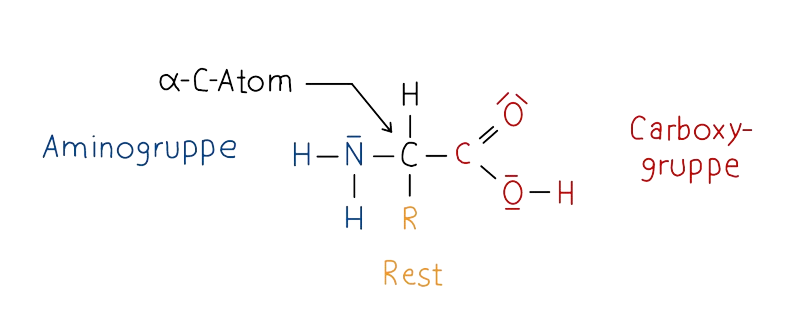
Almost all enzymes are proteins, and their structure and thus their function depend on several factors. Proteins are macromolecules composed of amino acids linked together by peptide bonds. They are formed from long chains of usually over 100 to more than 1000 individual amino acids. If a protein contains fewer than 100 amino acids, it is called a peptide. Each amino acid has two functional groups, the amino group and the carboxyl group. The sequence of amino acids determines the three-dimensional structure of the protein, which is of great importance for its function. A protein can be described on four structural levels: primary, secondary, tertiary, and quaternary structure.
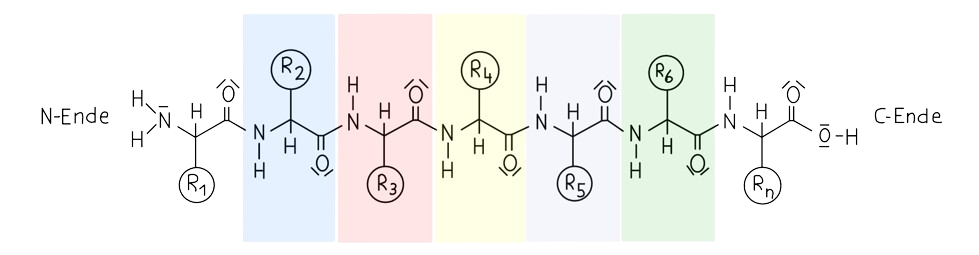
Primary Structure
The sequence of amino acids is called the primary structure, which is crucial for the three-dimensional structure of the protein. The amino acid chains each consist of a beginning that forms a free amino group and an end that consists of a carboxyl group.
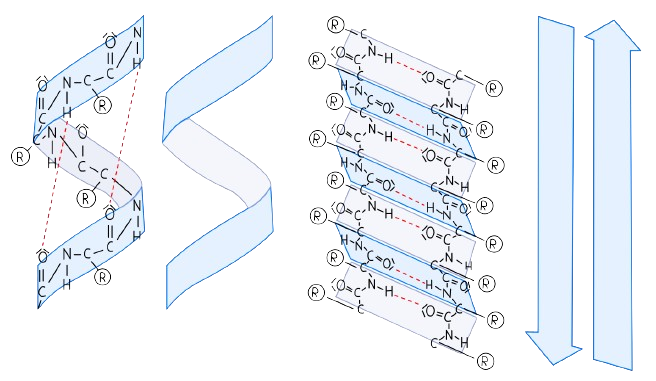
Secondary Structure
The secondary structure is determined by hydrogen bonds between the carbonyl (C=O) and amino groups (N-H) of individual amino acids. Common motifs such as the α-helix and the β-pleated sheet are often formed. In the α-helix, the amino acid chains form a spiral structure. This is due to the bonding of two amino acids that are four amino acids apart. The β-pleated sheet structure arises from the alignment of at least two amino acid segments of the same protein, creating a slight fold. The sequences can run parallel (in the same direction) or antiparallel (in opposite directions).
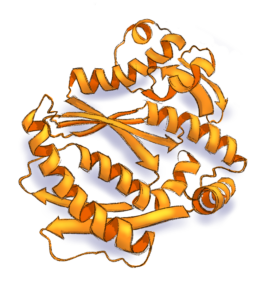
Tertiary Structure
The tertiary structure describes the overall three-dimensional shape of the protein. It arises from various interactions (hydrogen bonds, ionic bonds, van der Waals forces) and disulfide bridges.
Quaternary Structure
The quaternary structure describes the arrangement of different protein subunits in a protein complex. This can consist of identical or different proteins.
How does an enzyme work?
Enzymes are biocatalysts, meaning they are not consumed in a reaction but are only a part of it and accelerate its course. The role of an enzyme in a reaction is as diverse as the origin of the enzymes themselves.
Active Site
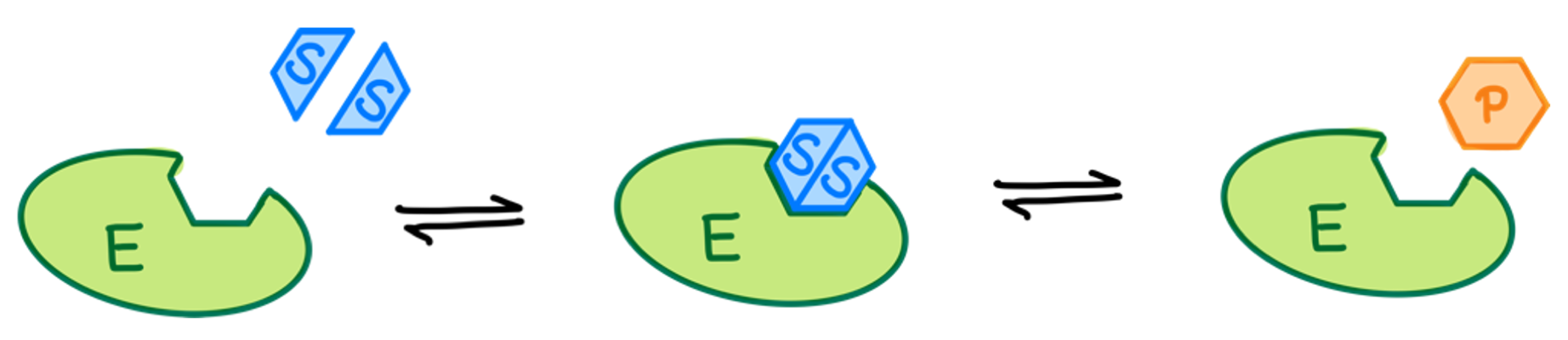
The active site of an enzyme is the location where the catalyzed reaction takes place. In an enzymatic reaction, the substrate binds to the active site of the enzyme. This forms an enzyme-substrate complex (Fig. 5). The substrate is then converted into the product. After the conversion of the substrate, the enzyme and the product are separated. But how do enzymes find the right substrate?
Enzyme Specificity
The lock-and-key principle describes how precisely an enzyme works with its respective substrate. You can think of it like a lock and a key: Only the right key can open the lock. The enzyme has a fixed shape that is precisely tailored to the substrate. This precise fit allows for targeted binding, so that only suitable molecules can trigger a reaction and no unwanted reactions occur.
In contrast to the rigid lock-and-key principle, the induced-fit model shows that many enzymes are not perfectly shaped from the start. Instead, they are flexible: when the correct substrate comes near, the enzyme specifically changes its shape to adapt even more closely to the substrate. This change in shape is called a conformational change. This has a great advantage: it increases specificity, i.e., the accuracy with which the enzyme recognizes its “correct” substrate. This is because only the appropriate substrate can trigger the necessary reaction in the enzyme, causing its structure to change. If an incorrect substrate tries to bind, this shape adjustment usually doesn’t happen at all – the connection is too weak or doesn’t fit properly. This prevents random or unwanted reactions from occurring.
Activation Energy
Every reaction has an activation energy that must be overcome for the reaction to proceed. Catalysts are used for this purpose, which lower the activation energy so that the hurdle is not so high. Enzymes accelerate the course of a reaction by lowering the activation energy required to form a new molecule. Energy is needed for every reaction (endothermic) or energy is released (exothermic). This energy can be provided, for example, by the temperature of the reaction medium. A reduction in activation energy means that the reaction can proceed with less energy input and is therefore accelerated. For most reactions in cells, the activation energy is too high, so the reaction could not occur without a catalyst, in this case, enzymes.

Where are enzymes used?
Many products that we use in our daily lives are produced using biotechnological processes and are essential for supplying the world’s population. Whether food or medicine, much of it is produced in complex biotechnological processes. The demand for the development and use of such biotechnological processes is increasing and is necessary to achieve sustainable production in the future.
Task: Where do you think enzymes are found in everyday life?
Task: And where are enzymes used in the food industry?
Source: https://jem.at/2014/ernaehrungsmedizin/enzyme-in-der-lebensmittelverarbeitung/
The data available to us dates from 2008.
A lot has happened in the industry since 2008. Chemical processes must become increasingly sustainable and resource-efficient, which is why further applications with enzymes have been and continue to be developed. Enzymes are mainly used in biotechnology.