
You have just learned that mushrooms can look very different and only a few look like me – with a cap and a stem. But what actually is a mushroom, what do we look like and how do we reproduce?
What is a mushroom?
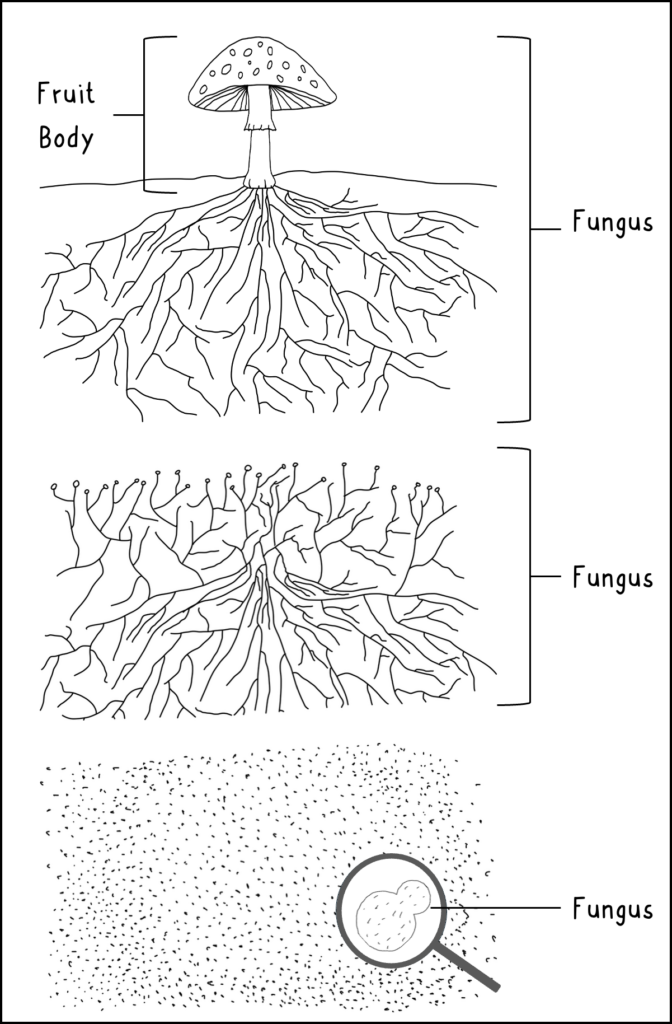
Mushrooms can have many different growth forms. Some form a fruiting body that sprouts from the ground in autumn. But what we see is only a small part of these specific mushroom species. The actual mushroom usually grows invisibly underground as a fine network of threads called mycelium. A large part of mushrooms consists only of this network and does not form a visible fruiting body. Others, like yeast fungi, remain unicellular and form neither a cap nor a network. You can clearly see the different forms in the picture. But how does a mushroom actually develop – and how does it grow?
How does a mushroom grow?
Most mushrooms develop from spores, which, similar to plant seeds, serve for the distribution and reproduction of the mushroom. While plant seeds are much larger and consist of an embryo and nutrient tissue, spores are usually tiny and unicellular. They are extremely resistant and can survive for a long time – even in extreme heat, cold, or dryness. This characteristic ensures the mushroom a greater chance of survival in extreme weather conditions. So that the mushroom can colonize new areas, spores are moved by wind, water, animals, or humans, for example. When the spore encounters favorable conditions, it germinates and forms fungal threads. The fungal threads are called hyphae. The hyphae then gradually form a fine network of fungal threads, the mycelium. To supply the mushroom with nutrients, the mycelium grows in the soil or in other materials and is therefore often invisible to humans.
However, a distinction must be made between unicellular and multicellular organisms from the outset.
- Multicellular fungi form a mycelium from the fungal threads described above, the hyphae, but not necessarily a fruiting body. The above-ground growth serves for spore dispersal and oxygen uptake. For this reason, we can admire more complex structures such as the well-known cap mushrooms in the forest, especially in autumn. Other multicellular fungi remain permanently in thread-like form and develop spore-forming structures that remain invisible to the human eye (Fig. 1).
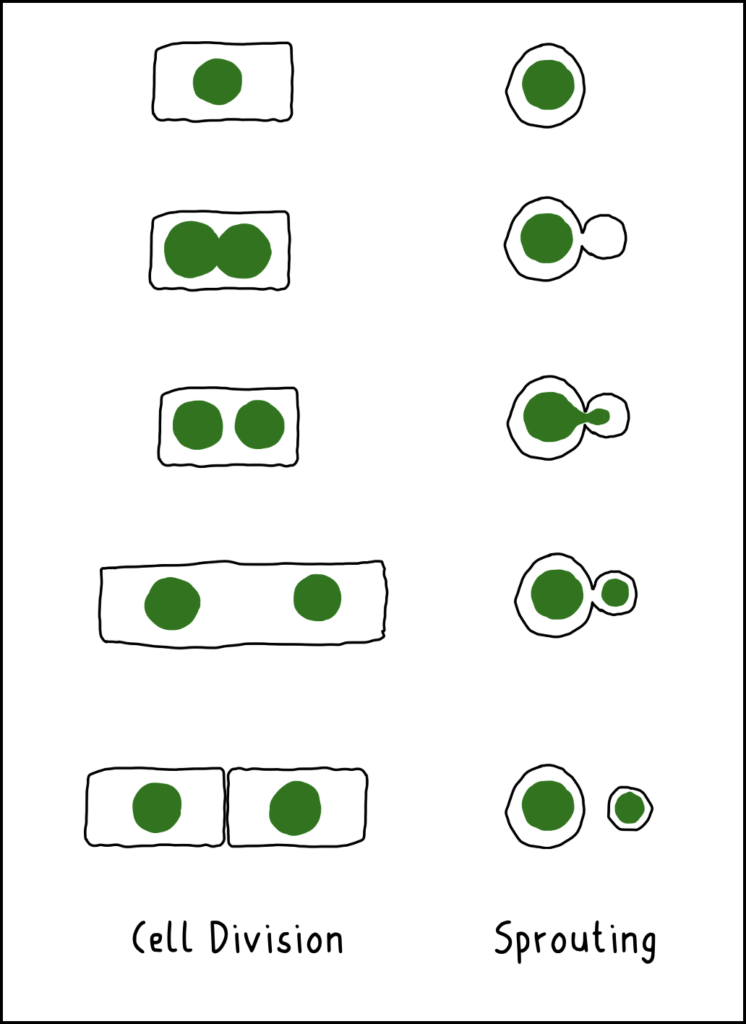
- Unicellular fungi, on the other hand, do not form mycelium and reproduce mainly by dividing individual cells. A well-known example is yeast fungi, which are used in the production of bread, wine, and alcoholic beverages (Fig. 1). A special feature of yeast cells is their reproduction by budding or sprouting. In contrast to classic cell division, where two daughter cells of equal size are formed, budding forms a small outgrowth on the mother cell, from which a smaller daughter cell initially develops (Fig. 2). Yeast fungi form spores under certain conditions – for example, at optimal temperature and humidity, or even under stress such as nutrient deficiency. This increases their chances of survival and reproduction under changing environmental conditions.
How do mushrooms mate?
Mushrooms can reproduce both asexually and sexually. In asexual reproduction, spore-forming structures develop from the mycelium, in which spores are formed. These grow into new mushrooms without the need for a second mushroom or a change in genetic information.
Sexual reproduction works differently: In mushrooms, there are not just two sexes like in humans, but many different sexes with different mating types. They cannot be distinguished externally – they can only be identified using laboratory analyses. The reproductive cycle begins with the mycelium, a network of fungal threads (hyphae). When two hyphae of different mating types meet, they can fuse. The cell contents merge, but the cell nuclei remain separate at first. In the now common hyphae, binucleate cells are formed, in which two cell nuclei – one from each mushroom – exist side by side. This state can be very short, depending on the mushroom species, or even last for several years. Finally, the two cell nuclei fuse and exchange their genetic material. Spore-forming structures, which can look different depending on the mushroom species, develop from these cells. New spores are formed within them. These spores are then released and can germinate under favorable conditions. A new mycelium grows from the germinating spore, and the reproductive cycle begins again.
Now you know how we reproduce. Can you arrange the pictures to form the life cycle of a mushroom?
When does a mushroom cap form?
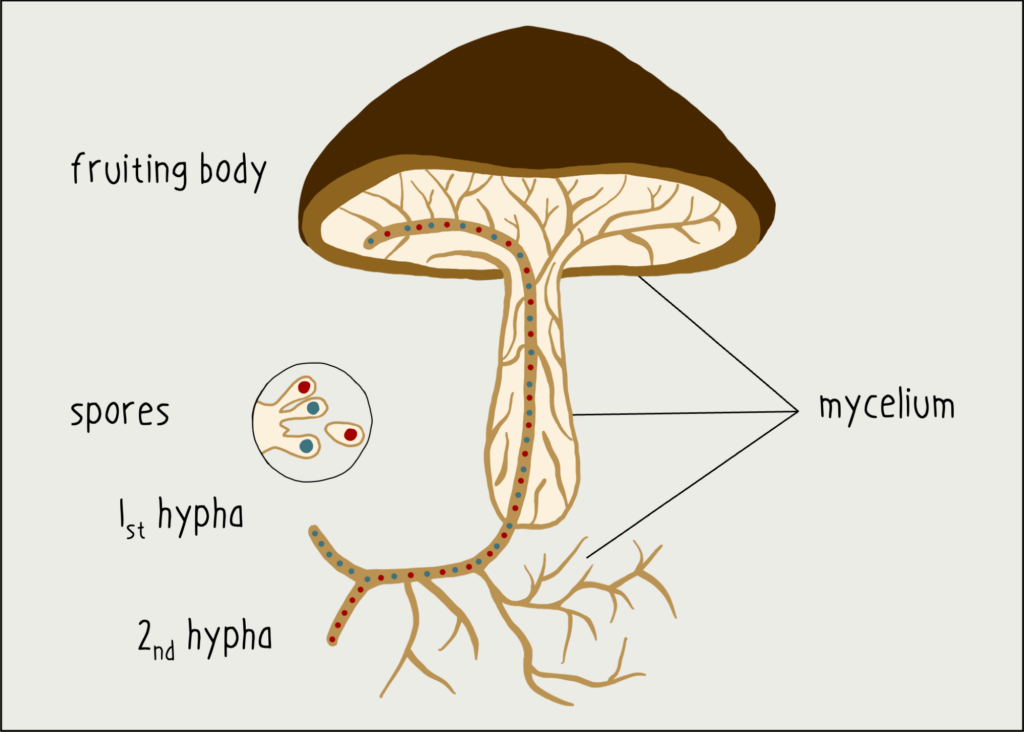
The visible fruiting body is only part of the life cycle for some species. However, in species that form fruiting bodies, it develops when two hyphae of different mating types fuse (Fig. 3). It can then grow out of the ground and become visible to us. Inside the cap, for example in the gills or pores, new spores are formed. The fruiting body of a mushroom can be compared to the fruit of a plant. Its main purpose is to enable reproduction through the dispersal of spores. While the cap usually only forms at certain times of the year, the mycelium remains in the ground all year round and can reach enormous dimensions. The largest known mycelium is an impressive 9 km2 – that’s about 1,260 football fields. So, the largest part of a mushroom is invisible to us, as it spreads, for example, under the ground or in wood. What we colloquially perceive as a mushroom is often just the “tip of the iceberg”.
Perhaps you would like to observe the life cycle of a mushroom with your own eyes? On the next page, we will show you how.