
We come in many colors and shapes – we grow in water or on land, can be useful or harmful. But have you ever wondered what we actually are? For a long time, we were counted among the plants, but today we know: We form our very own kingdom. But what does that mean exactly? And how do we differ from plants and animals?
What is biological systematics?
Click on the image for the English version.
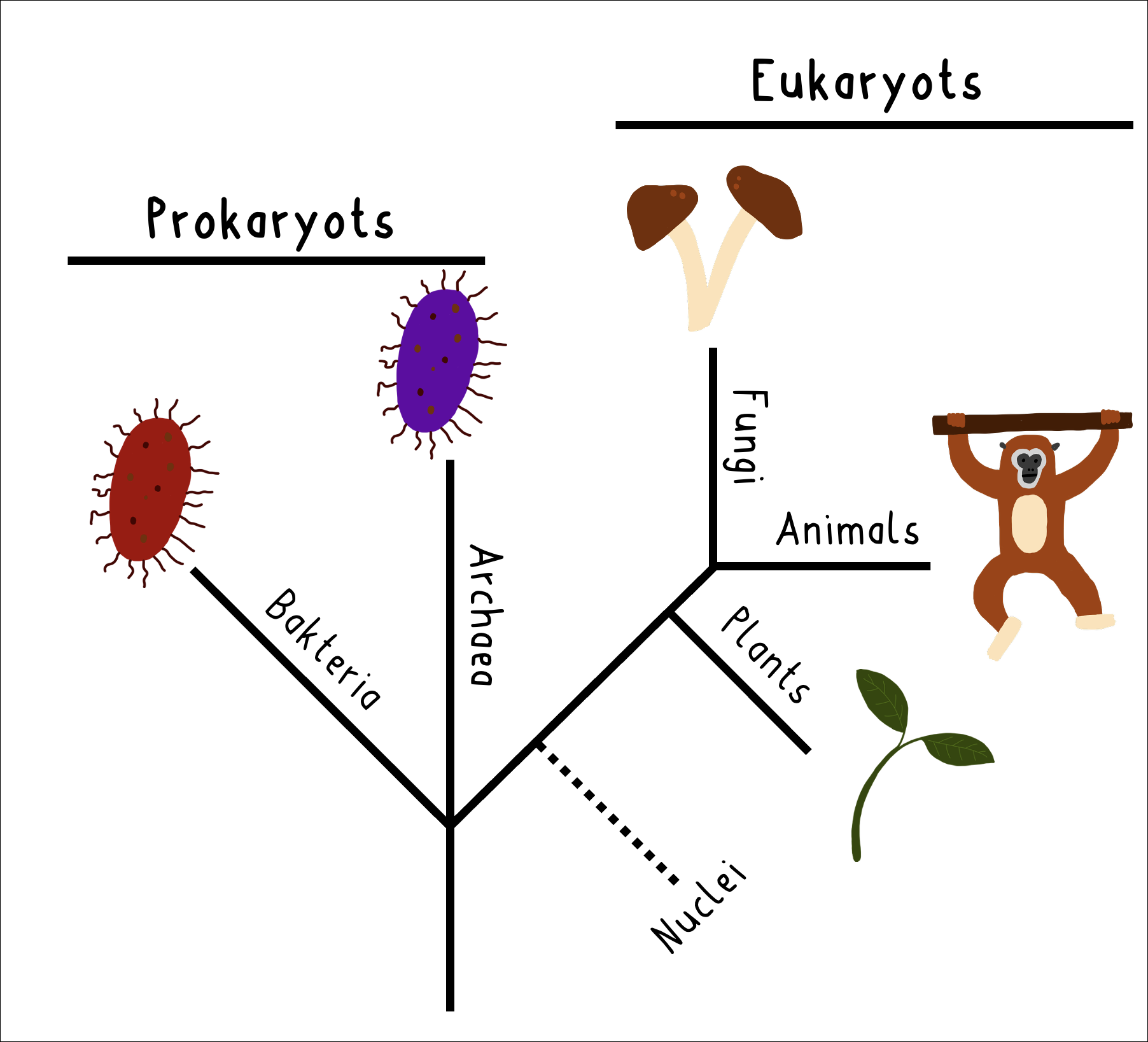
There are millions of different species in the world, so it can be difficult to keep track. Imagine all these species were products in a supermarket, but everything was randomly placed on the shelves. To find the groceries more easily, they are sorted into categories like fruits, vegetables, or dairy products. Biological systematics works the same way: Living beings are divided into groups based on their similarities (Fig. 1). At the very beginning, a distinction is made between organisms with a cell nucleus (eukaryotes) and those without (prokaryotes). Eukaryotes are further divided into the life forms plants, animals, and fungi. Until the late 20th century, it was thought that fungi belonged to plants. Today, it is known that they form their own group and are even more closely related to animals than to plants.
What distinguishes animals, plants, and fungi?
Most animals can be distinguished from plants or fungi at first glance because they can move. But how can it be that fungi, which look so similar to plants, are actually more closely related to animals? To understand this, one must look more closely at the cells.
A look into the cell
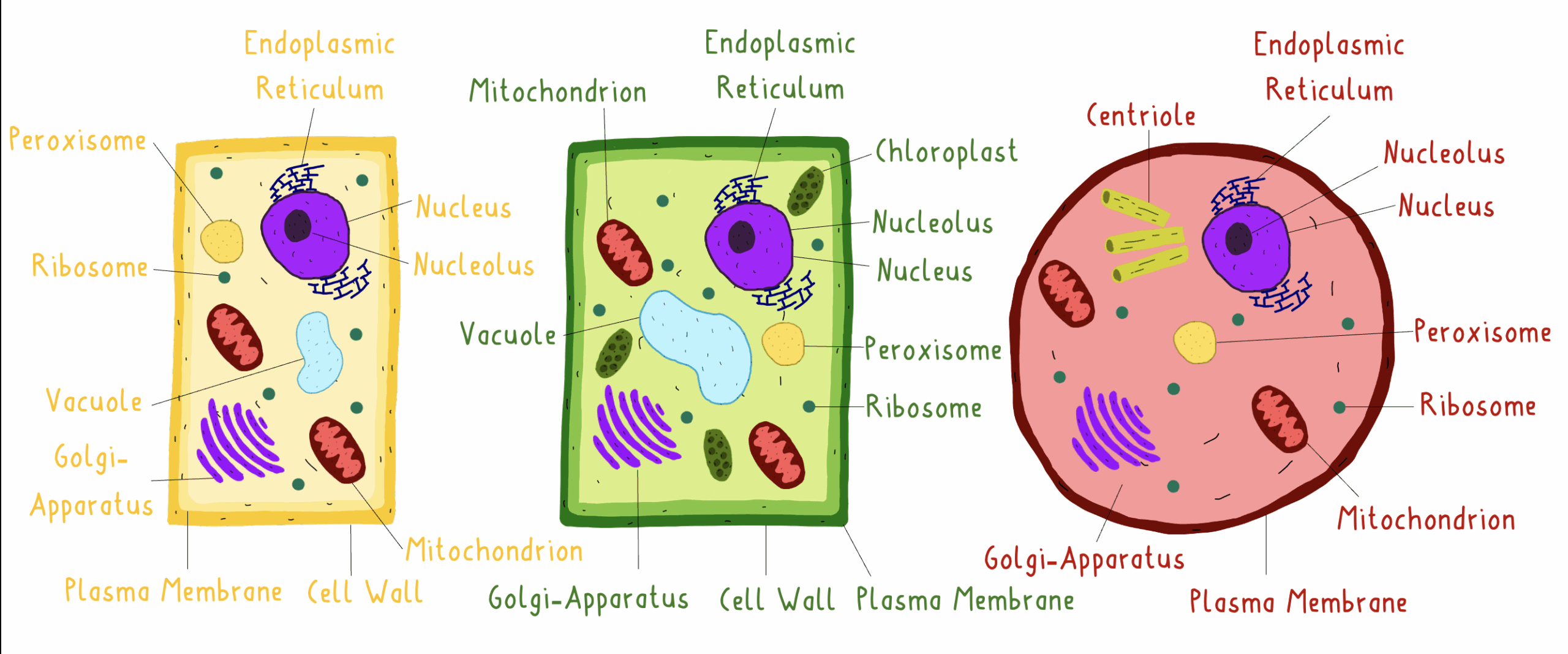
All living beings are composed of cells, which are surrounded by a protective membrane. Inside these are ribosomes, which link amino acids into protein chains. Eukaryotes – that is, animals, plants, and fungi – also have a cell nucleus containing their genetic material, DNA. Looking more closely at the cell structures of animals, plants, and fungi, one recognizes many similarities: They have mitochondria for energy production, an endoplasmic reticulum (ER) where a variety of proteins are produced, a Golgi apparatus responsible for the modification, sorting, and transport of proteins, and peroxisomes for the breakdown of harmful substances. However, there are also crucial differences. Plant cells have a cell wall made of cellulose, which gives them stability. They also possess chloroplasts, with which they use sunlight for energy production, as well as a large vacuole for fluid storage. Animal cells, on the other hand, have neither a cell wall, nor chloroplasts or a vacuole, but they do have centrioles, which play a role in cell division. Fungal cells are, in a way, a mixture of both: they have a cell wall and a vacuole like plant cells, but their cell wall is not made of cellulose, but chitin – a substance also found in the shells of insects (Fig. 5A). They also lack chloroplasts, which is why, unlike plants, they cannot generate energy from sunlight.
Click on the image for the English version.
Click on the image for the English version.
Click on the image for the English version.
What are the individual cell components important for? Consolidate your knowledge and solve the crossword puzzle.
Other differences
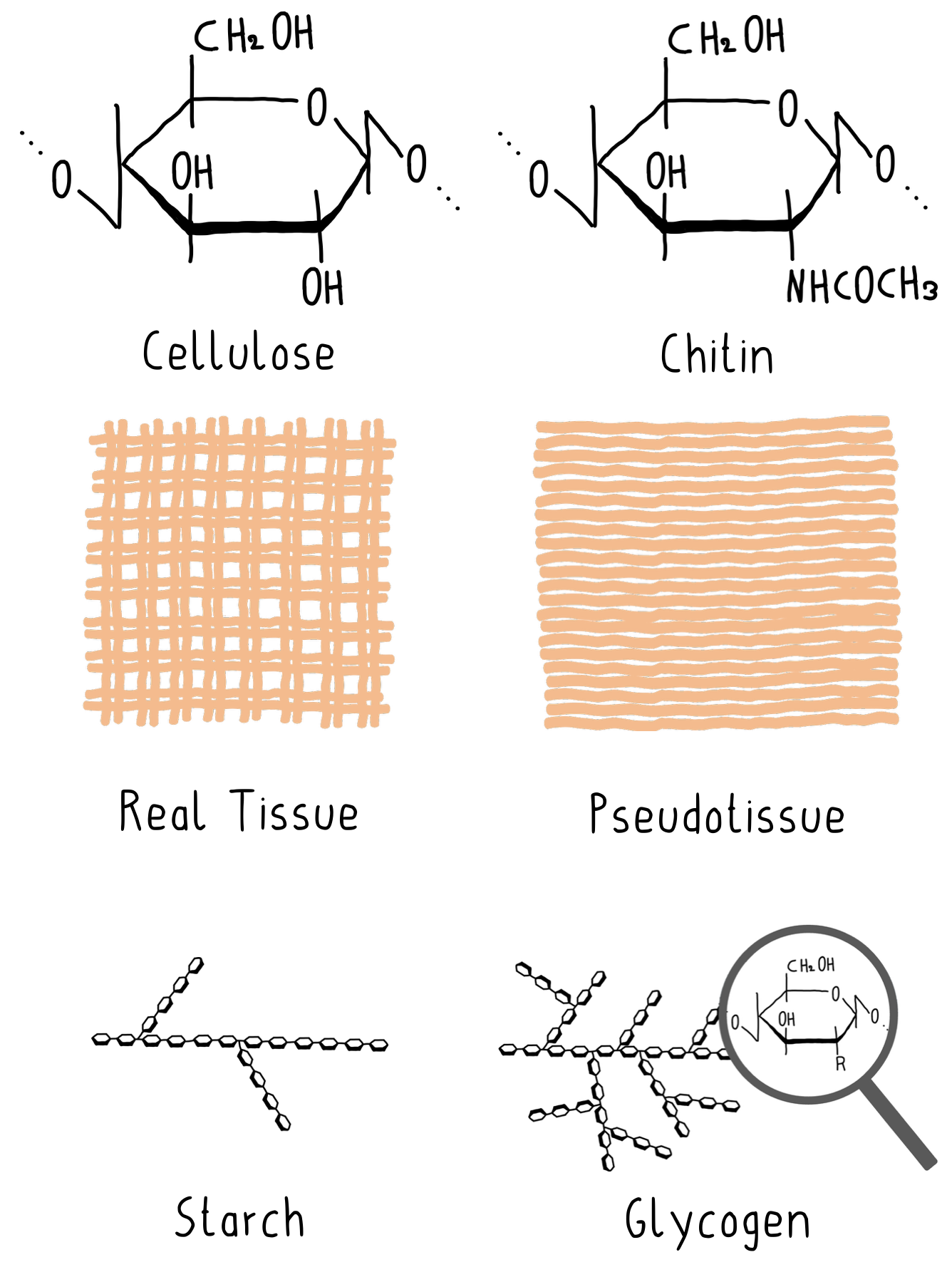
A. Cell wall components B. Tissue structures C. Sugar storage structures.
Click on the image for the English version.
Beyond cell structures, there are also significant differences between plants, animals, and fungi. While plants and animals have true tissues, where cells are connected to each other, fungi consist of hyphae that lie loosely next to each other, a so-called pseudoparenchyma (Fig. 5B). The way they obtain nutrition also differs: Plants can produce their own sugar through photosynthesis and store it as starch. Animals and fungi, on the other hand, must absorb sugar from their environment, but they store it in the form of glycogen, which is more branched than starch (Fig. 5C). Another significant difference is in digestion. Animals ingest food through their mouths and break it down in their bodies using enzymes. Fungi, however, secrete their enzymes externally, causing their food to be broken down outside the body before the nutrients are absorbed.
Complete the table on the differences between plants, animals, and fungi. The terms are already sorted by column.
Solution for the table Differences between plants, animals, and fungi
The fact that fungi are more closely related to animals than to plants could not only be determined based on these characteristics, but was also confirmed by DNA analyses. Comparing the genetic material of fungi with plants and animals shows that fungi are indeed genetically more similar to animals. These findings lead to fungi being considered a separate group within living organisms and no longer classified as plants. But is a fungus more than “just” the mushroom cap in the forest? What different types of fungi are there anyway?