
Lactose
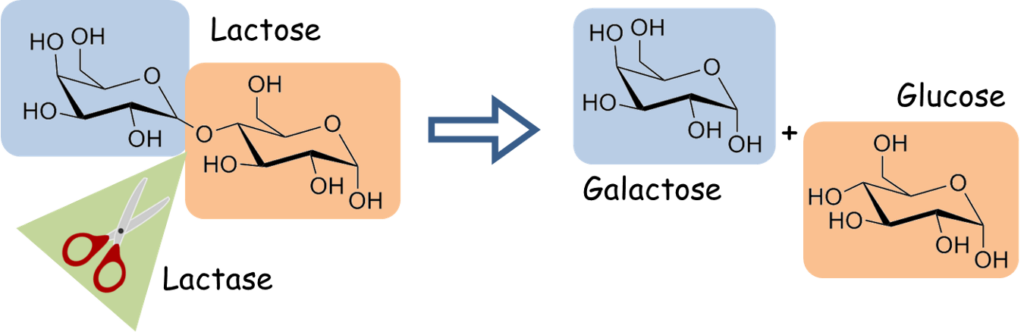
Lactose is also known as milk sugar and is a component of mammalian breast milk. Lactose is the main energy source for newborns, and every healthy newborn mammal is able to break it down. It is a disaccharide consisting of the monosaccharides glucose and galactose.
How is lactose broken down?
Lactose is broken down into the two simple sugars D-glucose and D-galactose with the help of the enzyme lactase (also β-galactosidase). This enzyme is produced in the small intestine and is necessary to prevent lactose from interfering with digestion.
What is lactose intolerance?
In most people, lactase activity drops to 5–10% of the original value once they are no longer breastfed. In about 90% of cases, however, the cause of an inactive or missing enzyme can also be a disease that leads to insufficient lactase production. This causes undigested lactose to enter the large intestine and be fermented. This produces lactic acid, acetic acid, hydrogen, carbon dioxide, lactate, and CO2, leading to bloating and cramp-like abdominal pain. The short-chain fatty acids produced during fermentation cause nausea and vomiting. Lactic acid causes water to be drawn into the intestine, which leads to diarrhea.
What can be done about it?
Lactase tablets
These preparations are available over-the-counter and can be purchased in almost any supermarket or drugstore. The tablets contain a defined dose of an enzyme that must be taken before consuming lactose-containing products so that the preparation reaches the intestine before the lactose.
Lactose-free products
Many products are now available as lactose-free alternatives. In these products, lactose is enzymatically broken down by adding lactase. A product is considered lactose-free if it contains less than 0.1 g of lactose per 100 g.
Some dairy products such as yogurt or cheese are naturally low in lactose or even lactose-free due to the microorganisms used. Here, lactase is produced by microorganisms during cheese ripening, which breaks down the lactose.
The amount of lactose that each person with lactose intolerance can tolerate varies greatly. While some can tolerate small amounts of lactose well, even the smallest amounts can cause discomfort in others. Therefore, each person should try out individually what amounts they can tolerate.