
When talking about enzymes in sustainable production, one organism cannot be missing: yeast. As a representative of fungi, yeasts belong to one of the oldest and most versatile groups of microorganisms that have always used metabolic processes to break down and convert organic materials. Yeast is particularly valuable for industrial applications because its enzymatic activity makes numerous processes efficient, resource-saving, and versatilely controllable – from food production to biotechnological production.
We are usually referring to Saccharomyces cerevisiae, also known as baker’s yeast or brewer’s yeast. It plays a central role in the leavening of baked goods and the fermentation of alcoholic beverages. Its cells produce enzymes that act either within the yeast or are secreted to break down and absorb substances from the environment.
Where is yeast used?
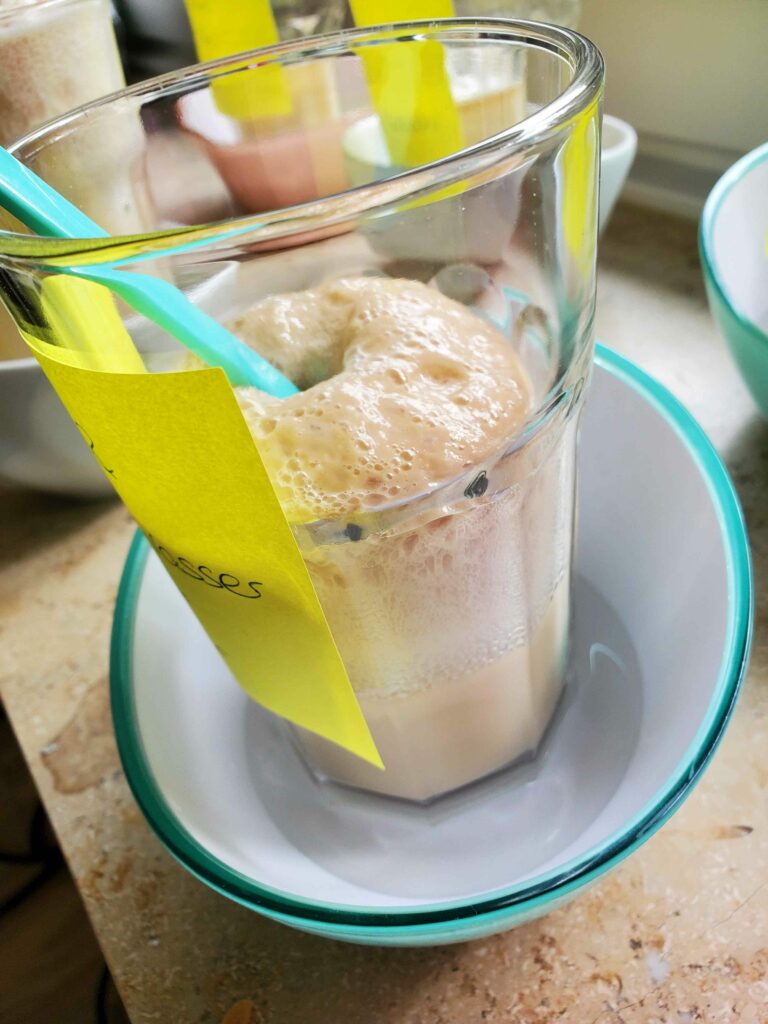
Yeast is an organism with an active metabolism controlled by a variety of enzymes. These enzymes perform central tasks in the breakdown of sugar and energy production. First, household sugar (sucrose) is split into glucose and fructose by enzymes. In further enzymatic steps, this results in pyruvate, an important metabolic intermediate. With sufficient oxygen supply, this pyruvate is completely broken down into carbon dioxide (CO₂) and water. However, if oxygen is lacking, yeast switches to anaerobic metabolism and performs alcoholic fermentation. This produces CO₂ and ethanol.
Baked goods
In baking, yeast serves as a leavening agent. The yeast’s enzymes break down sugar, producing CO₂. This forms small gas bubbles that loosen the dough. When heated, the bubbles expand and provide the characteristic volume and a light crumb.
Alcoholic beverages
Here, yeasts are specifically used to enzymatically convert sugar into alcohol and CO₂. The alcohol tolerance varies depending on the yeast strain: brewer’s yeasts work up to about 8% by volume, wine yeasts up to 16–18% by volume.
Yeast extracts
For yeast extracts, yeast cells are killed by acid, solvents, or ultrasound. The cells release their enzymes, which break down the contained proteins and nucleic acids (autolysis). This enzymatic process leads to the release of glutamate and other flavor-enhancing substances that are added to many foods.
For yeast to reach its full potential, it is important to understand the conditions under which it grows optimally and metabolizes substances.
How does yeast grow?
A small bud (budding) forms on the cell wall of the yeast cell, and at the same time, nuclear division begins. All chromosomes double, and a pair of chromosomes moves into the bud. The bud is now the daughter cell and separates from the mother cell once it reaches a certain size. This process can take several hours, depending on the food supply and environment.


How does temperature affect yeast growth?
Temperature is a crucial factor for yeast growth and enzymatic activity. The optimal growth temperature is between 25 °C and 30 °C; in this range, the enzymes work most effectively. They break down sugar into smaller molecules, initiate metabolic pathways, and drive cell division.
If the temperature drops, metabolic activity and thus enzyme activity slow down. However, some yeast strains, such as those used in large breweries, are adapted to cooler temperatures and can still use their enzymes effectively under these conditions.
If, on the other hand, the temperature rises above 35 °C, the yeast comes under heat stress. Enzymes can denature, meaning they lose their structure and thus their function. Furthermore, these temperatures favor the growth of unwanted microorganisms.
What about salt content?
Even low salt concentrations exert osmotic pressure on yeast cells and draw water out of them. This means stress for the cells, which they can compensate for to a certain extent with the help of their enzymes. Enzyme activity decreases, leading to slower cell growth and a more leisurely fermentation. However, this slowdown can also contribute to a more complex flavor profile and better dough structure.
What is the purpose of oil in dough?
In many yeast baked goods, oil is added to the dough. Oil can form a barrier around the yeast cells in the dough, influencing the interaction between the yeast and other ingredients such as water, sugar, and salt. This makes it more difficult for the yeast’s enzymes to access nutrients, slowing down metabolism. At the same time, oxygen supply decreases, causing the yeast cells to switch to anaerobic metabolism. This produces more CO₂ and ethanol, which loosens the dough.
Further content on the topic of yeast
We have more to offer on the topic of yeast. If you are still interested, take a look at our other offers.