
What is a bubble column?
The reaction rate can not only be increased by adding more enzymes to a reaction, but also by distributing the enzymes better in the reaction space – so that the enzymes and the substrate are well mixed. This can be done by stirrers or, as here, by bubble columns.
Various reactors are used in the production of biotechnological and chemical products. A bubble column is a column filled with liquid through which air bubbles rise from the bottom. The air bubbles serve various purposes depending on the reaction, such as mixing the liquid or supplying the reaction with oxygen.
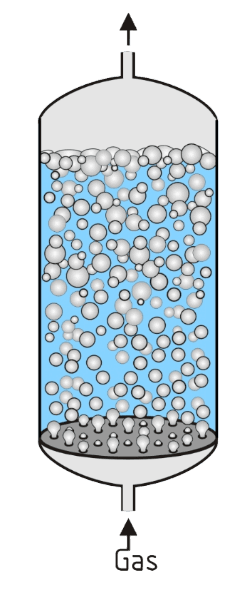
In this type of reactor, the energy supply is provided by the dispersed gas phase. Gas is introduced through a perforated plate or other devices at the bottom of the column, causing gas bubbles to rise through the column and form an interface between the gas and liquid phases, allowing for optimal gas exchange. The gas phase thus fulfills two functions in the sustainable process: on the one hand, it serves to mix the reaction media, with only slight impairment of the mechanical stability of the heterogeneous biocatalyst used. On the other hand, it shifts the reaction equilibrium in favor of the product by removing the reaction water formed.
Required materials:
• Aquarium pump (available for a few euros at a pet store)
• Clear glass with straight walls (e.g., Kölsch glass, vase) 200 – 400 mL
• Straws (should be longer than the height of the glass and preferably have a bendable section)
• Hoses
• Oil (e.g., sunflower oil, rapeseed oil, or olive oil)
• Water
• Lipase or enzyme mixture with lipase from a drugstore or online shop
Experiment description
First, connect the aquarium pump to a straw using a hose and check for leaks. It is also advisable to first check the air delivery rate of the pump in a preliminary experiment with only the two liquids and without the enzyme. This way, you can avoid overflowing the oil-water mixture by adjusting the amount of liquid. Mixing begins when the pump is switched on. By varying the experimental conditions, the mixing and bubble size can be optimized. In the first video, you will learn how to do this.
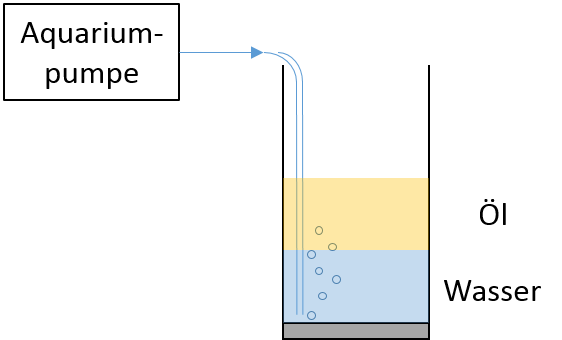
Hydrolysis of lipids with a lipase
Once you have completed the preliminary experiments, you can add the lipase or the enzyme mixture with lipase to the glass. If the powder was purchased in capsules, break open the capsules and use only the powder. Fill a quarter of the glass volume with water and swirl briefly to dissolve or distribute the powder well. Then add a second quarter of the glass volume of oil and attach the straw, which is connected to the aquarium pump, to the bottom of the glass and fix it there.
What else you can try:
- The mixing depends on the inner diameter of the straw and the air pump rate. Experiment with straws of different inner diameters and reduce the pump rate if you have an adjustable aquarium pump.
- Experiment with different materials at the air outlet of the straw to vary the size of the bubbles.
- To measure the effectiveness of mixing the two phases, let your experiment run for a certain time (2 minutes) to mix the two phases, then turn off the aquarium pump. How long does it take for the two phases to separate clearly again? Do you notice a connection?