Have you ever wondered why an apple or a banana turns brown? Imagine you’ve spent an hour in the kitchen washing your fruit and lovingly cutting it into small pieces. Just as you’re about to put all the ingredients into your blender to make a delicious smoothie, all the fruit pieces have turned unappetizingly brown. You can no longer serve this smoothie to any guests. Even if you hurry next time and cut your fruit at lightning speed, it will have turned brown at the latest after blending. Damn, you think. What’s the reason for this? Is there a remedy? Because you want to show your new smoothie creation to your friends who live a bit further away. To find out, you start a series of experiments.
You need for the experiment
- 2 apples
- 1 packet of citric acid
- 1 lemon
- 1 tablet of vitamin C (ascorbic acid)
- 4x 100 ml water
- 1 knife
- 1 cutting board
- 1 blender
- 4 glasses
Conducting the experiment:
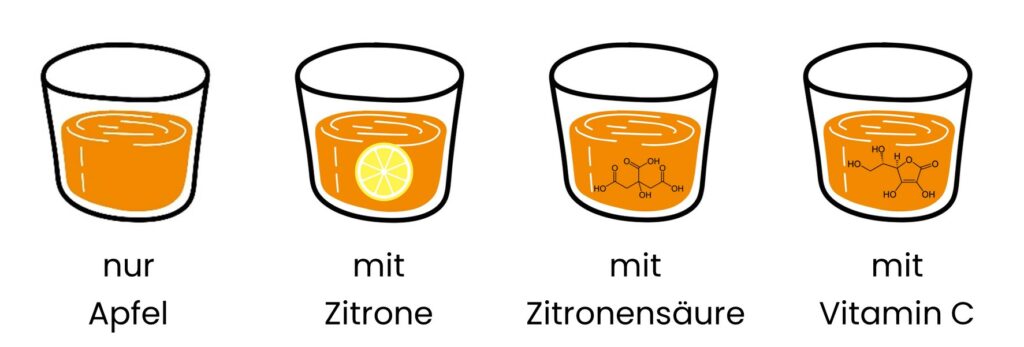
Halve the apples. For the individual experiments, we only need one apple half each. This will give us 4 portions with which we will conduct 4 different experiments. The apple halves are cut into smaller pieces. The individual portions are each placed in a blender with 100 ml of water and pureed at medium speed for 30 seconds. The first portion is done without adding any other ingredients and is placed in the provided glass after pureeing. This portion serves as a reference against which we will compare the results from the other experiments.
Before blending, we add a different component to the other portions. To the second portion, we add the squeezed juice of a whole lemon, to the third portion, a packet of citric acid, and to the fourth and last portion, a crushed tablet of vitamin C. After blending, all portions are also poured into their respective glasses. Then it’s time to observe! How does the content of the glasses change over the course of an hour?