

While the yeast dough is rising, enzymes in the yeast become active. Enzymes are used to break down or build up substances. In our example, the substance was broken down. The enzyme remains unchanged after its work is done. It is a so-called catalyst, which accelerates reactions.
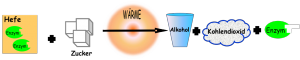
If the yeast is warm and “fed” with sugar, it starts to work. While the dough is rising, the yeast releases enzymes into the dough, which further break down the sugar into alcohol and carbon dioxide.

As you have already observed during your experiments, enzymes like warmth and sugar; they can’t do anything with cold and heat. In search of the perfect pizza dough, we will explore the conditions under which the dough rises best. To do this, we want to take a closer look at what the enzymes in the yeast like and what they don’t.
With further series of experiments, we want to find out:
- What happens when you vary the amount of sugar?
- What is the optimal “rising temperature”?
- How does yeast react to salt and oil?
The experiment instructions explain how you can investigate the above questions.
Task: Choose one series of experiments to carry out by the next mission. Discuss your results with the others and post pictures of your experiments in the community.
Tip for teachers and students who want to know more:
Further experimental series on yeast with information can be found here.
Back to Mission Overview