
If you couldn’t perform the experiments, here is a first video, the others will follow soon.
And what does this have to do with process engineering?
The selection of agitators and the calculation or experimental determination of mixing processes is a sub-area of Mechanical Process Engineering. There you deal with the conversion of material systems through predominantly mechanical influences. This includes
- mixing
- separation using mechanical methods, e.g. sieving, filtering
- comminution of particles and liquids
- enlargement of particles (agglomeration)
- transport and storage of solids (with the difficulties sometimes associated with it, such as blockages)
The four agitators used are compared here in a table:
| Disc agitator | Angled blade agitator | Helical ribbon agitator | Anchor agitator | |
| Flow direction | radial | axial | axial | radial |
| Flow profile |  |  | 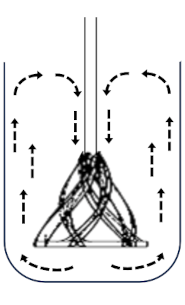 |  |
| Position | wall-distant | wall-distant | wall-near | wall-near |
| Shear rate | high | medium | low | low to medium |
| Agitation tasks | gassing, emulsifying | homogenizing, suspending | homogenizing, heat transfer | heat transfer |
| Typical applications | fermentation, gas introduction | liquid mixing, solid suspensions | polymerization, highly viscous media | very viscous liquids, pastes |