
What does sustainability actually mean?
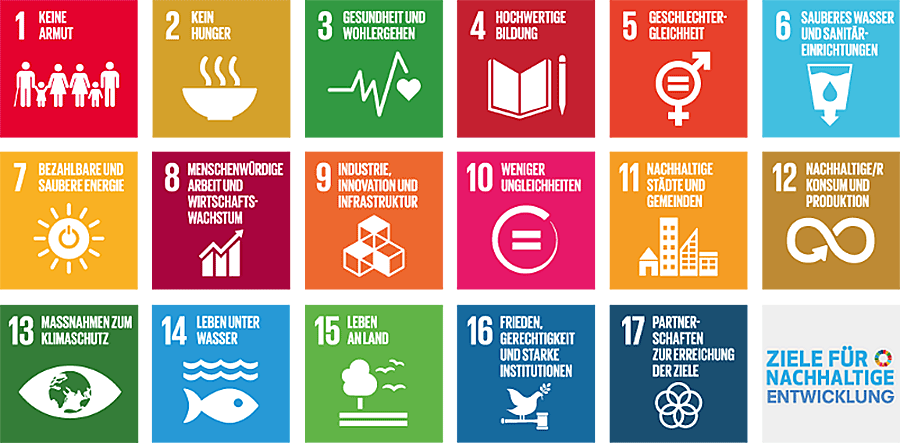
Sustainability means meeting the needs of the present without compromising the ability of future generations to meet their own needs. Sustainability has three different aspects that need to be considered: economy, ecology, and social justice. In 2015, the member states of the United Nations formulated the 17 Sustainable Development Goals, which are to be achieved by 2030. These goals are strongly interconnected and designed to be globally and universally applicable. This is an ambitious goal that is of great importance for the future of all people.
CO2 emissions as a global problem
Industry is still responsible for around 8% of annual CO₂ emissions and therefore naturally has a significant influence, but also a great responsibility. Energy provision is responsible for over 28% of CO₂ emissions in Germany. This clearly shows the potential for energy savings.
But we are also responsible for CO₂ emissions. In 2023, Germany had a CO₂ consumption per capita of approx. 7 tons. That’s about 70 chocolate bars.
But why are CO₂ emissions so bad?
CO₂ is one of the most frequently caused greenhouse gases by humans. This intensifies the greenhouse effect, the Earth gets warmer, and climate change is further driven. This leads to more and more consequences such as droughts, storms, floods, and much more. In addition, CO₂ remains in the atmosphere for several hundred years.
Therefore, it is very important to save CO₂ and emit as little as possible.
What can we do?
To reduce CO₂ emissions, we can also do a lot ourselves, for example, drive less and use public transport, bicycles, or walk instead. Furthermore, one can choose an electricity provider that offers green electricity and save energy at home by turning down the heating, using LED lamps, and buying more durable products.
However, industry accounts for the largest share of CO₂ emissions, and only if it becomes climate-neutral can anything truly change.
What can industry do?
Institutes such as the Institute for Technical Biocatalysis (ITB) at the Hamburg University of Technology (TUHH) are researching numerous solutions to make industrial processes more climate-friendly. Currently, many chemical reactions in industry function with the help of chemical catalysts. The ITB is trying to replace chemical catalysts with biological ones. These are usually enzymes. This allows lower temperatures to be used, CO₂ to be saved, and production to be more sustainable.
However, climate change is not a local problem and requires international solutions to promote sustainability.
One example of cooperation is the alliance (HUB) of United Nations (UN) Universities (UNU), “Engineering to Face Climate Change”. This cooperation brings together international expertise and technical innovation to jointly tackle the challenges of climate change. TUHH, with its ITB, is also part of this HUB. This partnership between TUHH and UNU aims to develop innovative strategies for better resource utilization, public information, and the training of researchers worldwide.
©frameless/David Laubmeier
Why is biocatalysis of interest?

But what makes biocatalysis so interesting? There are many different reasons why biocatalysis is important, and some of the sustainability goals are more prominent here.
Energy-saving reactions
In times of more sustainable products, energy transition, and energy crises, enzymes are gaining increasing importance. The temperatures of biocatalytic reactions are significantly lower than those of most conventional chemical reactions. The reason for this lies in the optimal reaction temperature of enzymes, which are adapted to their natural environment. Reactions with biocatalysts generally do not require high pressure either, which saves a lot of energy.
Fewer raw materials
Enzymatically catalyzed reactions offer the possibility of using fewer raw materials. Biocatalysts are needed in much lower concentrations than chemical catalysts. Milder pH values in the reaction medium also mean that fewer acids and bases need to be used to achieve a synthesis.
Fewer by-products
Due to their reaction and substrate specificity, enzymes typically perform only one type of reaction and convert only a specific substrate. This property allows the conversion to take place even in a mixture of different substances. Even enantiomers of a substance can be distinguished by enzymes, and only the specific molecule is converted. Fewer by-products also mean fewer production steps to obtain the final product.
Changing processes
So what can we do to become more sustainable? We will try to illustrate this using the example of a cream. We will discuss what ingredients are needed to produce a cream. Where do they come from and what alternatives are there to produce them? What can we change about this product to make it more sustainable?