
Observation:
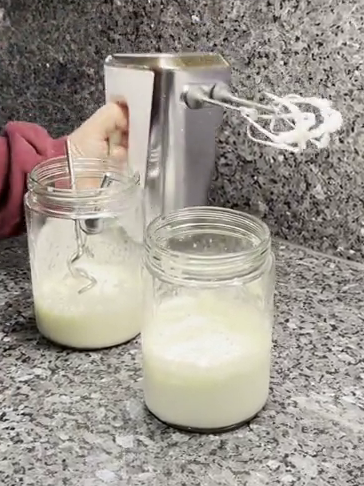
This is what the result looked like for us. Cream does not become as airy with dough hooks (see glass at the back in the picture).
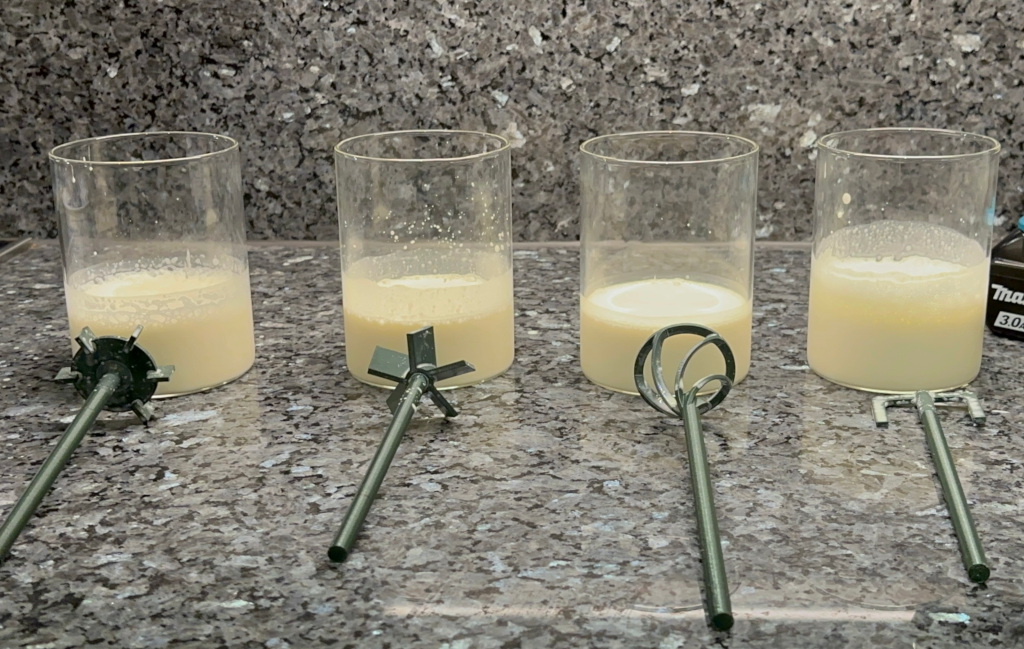
With the 3D-printed whisks, the result shown below was achieved. The disc stirrer might be suitable for stirring a sauce, but it doesn’t incorporate much air. According to theory, it is used for gassing. Disc stirrers and helical stirrers have slightly different flow behavior depending on whether they are rotated clockwise or counterclockwise, but in neither direction of rotation was much air incorporated. Only with the anchor stirrer did the cream become somewhat foamy.
For those who cannot perform the experiment themselves, here is a video:
Explanation:
When whipping cream, incorporating air is important. Whisk attachments are better suited for this than dough hooks. They create a vortex that incorporates air into the cream. Due to their larger outer diameter, the speed per revolution is higher, and consequently, the shear force that occurs during stirring is also higher. This divides the incorporated air into very fine bubbles.
Since cream is a low-viscosity liquid, it does not offer as much resistance to the stirrers as, for example, a yeast dough. A yeast dough requires the stronger, slimmer dough hooks.
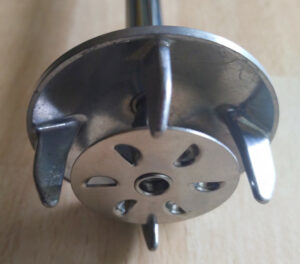
Alternatively, an immersion blender with a whisk attachment can also be used for whipping cream. This is a disc with holes that rotates during operation and generates high shear forces, creating particularly small air bubbles, which makes the cream firmer and keeps it stable for longer.
Air is whipped into the cream through stirring. The proteins in it hold the air in many small air bubbles. Around these bubbles, the milk fat in the cream forms adhering layers, preventing the bubbles from collapsing. This works better the colder the cream is (approx. 4 °C is ideal), the higher the fat content, and the “riper” the cream is: it needs to mature in the refrigerator for about two days so that the proteins become more elastic and stretchable. However, you don’t need to worry about this, as it already happens at the dairy.
Also interesting:
- Frozen cream can no longer be whipped because the ice crystals destroy the structures of fat and proteins.
- In UHT cream (ultra-high-temperature treated cream), the proteins are damaged by heat, making it difficult to whip.
- Whipped cream releases unbound water after a few hours, causing it to lose its structure and airy consistency. Therefore, binding agents such as cream stiffener or gelatin are added to cream cakes to bind the free water. These binding agents form gels with the water (More on this in our Aerogel Mission). And what are they made of? Cream stiffener consists of modified starch (i.e., gelatinized by hot water). Gelatin is a swellable protein.
- In bakeries and pastry shops, cream is whipped using so-called cream whippers. In this process, a compressor blows air into the cream container from below, while a rotating whisk grid in the container ensures good mixing.
Source: Das Bäckerbuch in Lernfeldern ISBN 978-3-582-40205-9
And what does this have to do with process engineering?
When using stirrers for the large-scale production of chemicals, cosmetics, pharmaceuticals, and much more, selecting the appropriate one for the stirring task plays an important role. You can find more information on this in the experiment “Mixing with 3D-Printed Stirrers“. Similar to the cream whipper, gases are sometimes mixed with liquids in industrial processes. These apparatuses are called bubble columns.