
– We start with a delicious smoothie!
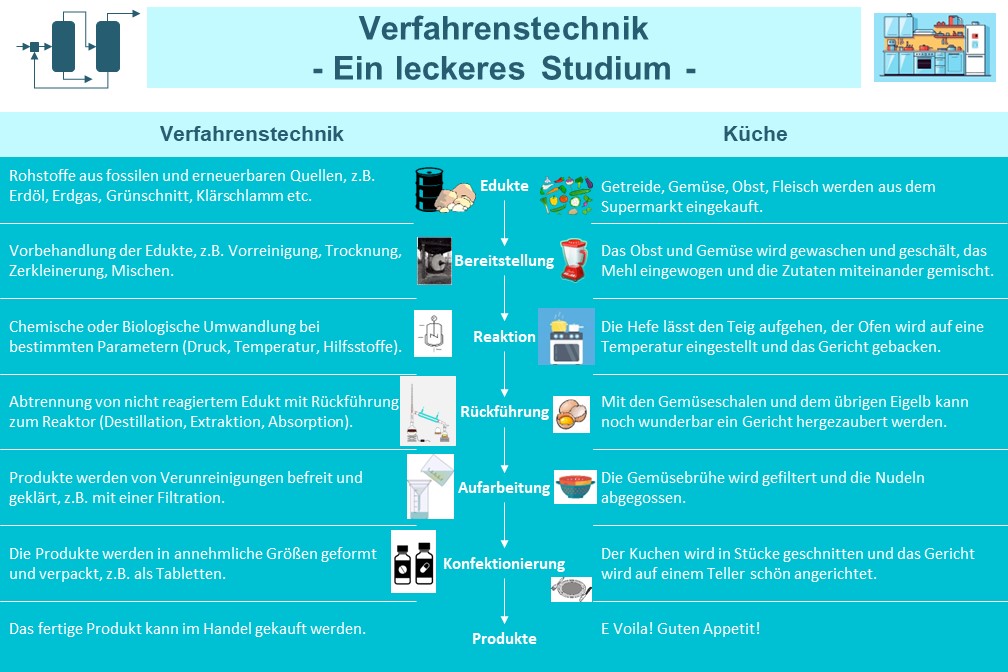
Using a smoothie, it’s quickly shown that the content of degree programs in process engineering or chemical and bioengineering is not so far removed from experiences you can have in the kitchen. The flow diagram below shows the connections again in an overview. Clicking on the image will enlarge the overview.
What is Process Engineering?
Definition
Process engineering is the engineering discipline that deals with the development and optimization of processes for material transformation. In this process, the composition, type, or properties of the materials change. This transformation takes place in several targeted steps and can include chemical, physical, and biological processes. The goal is to produce products that have specific properties and qualities. A major focus is placed on the efficiency of the processes to make them economically viable and sustainable.
Process Flow
The process of material transformation is typically divided into two main phases:
Upstream processes: These involve the preparation and treatment of raw materials. This includes steps such as grinding, mixing, dissolving, separating, or generally preparing the starting materials.
Downstream processes: These include the processing and refinement of intermediate and final products. This includes separation of product mixtures, purification, drying, and packaging.
A bit more illustrative, please?
Process engineering can be illustratively compared to a kitchen or a laboratory. In a kitchen, ingredients (raw materials) are transformed into dishes (products) through various cooking techniques (processes). Here, the individual steps must be precisely coordinated to achieve a successful end product. Upstream steps include, for example, washing and cutting the ingredients, while downstream steps include, for example, removing spice bags, garnishing with chives, or simply arranging and serving.
A significant aspect of process engineering is so-called scale-up, i.e., the transfer of processes from small laboratory or pilot plants (private kitchen) to large-scale production plants (canteen/cafeteria). This step is particularly challenging because processes do not always behave linearly and require special adjustments to function safely, efficiently, and economically on a larger scale.
Process engineering is a key technology that finds application in many industries, including chemistry, pharmaceuticals, food technology, and environmental technology. It enables the efficient and sustainable production of products that are indispensable in our daily lives.
Overview of the different areas of process engineering




Want even more information?
If process engineering/chemical and bioengineering could be something for you, then browse through this flyer from the VDI.

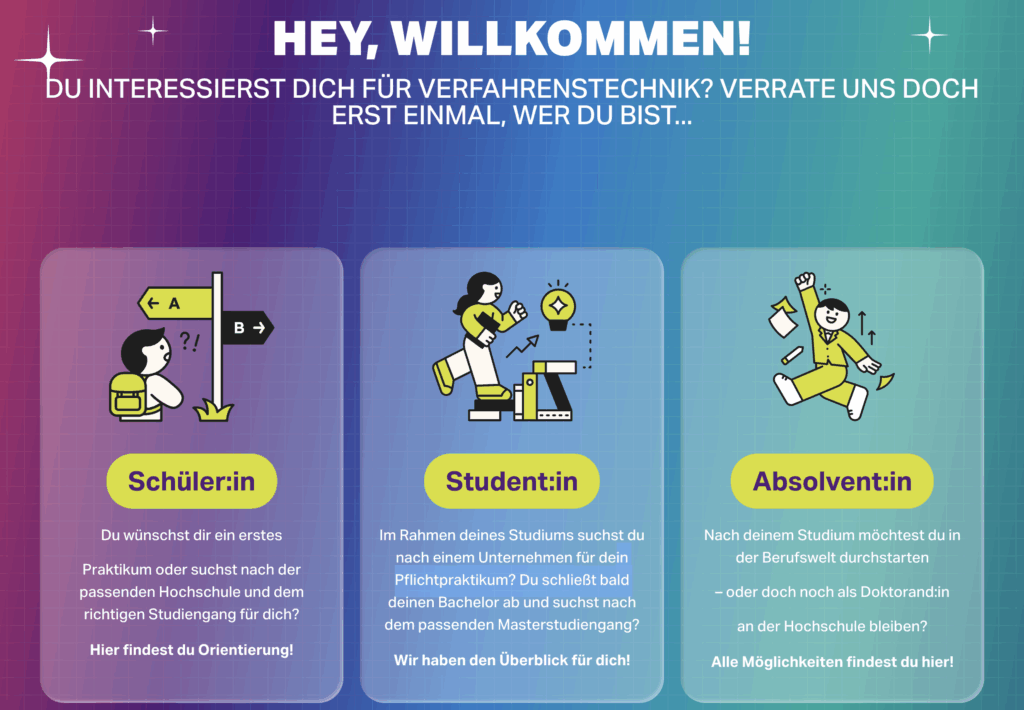
Or visit https://pro3tech.de/, a competence network for process engineering, bioengineering, and chemical engineering in Germany. It connects universities, research institutions, and companies to jointly drive innovation and strengthen process engineering. It also helps to find out if process engineering is the right field for you – suitable for pupils, students, and graduates.