

We know now that white light contains all colors. But how do objects get their colors? For example, why are roses red? If you have an idea, tell us in the comments.
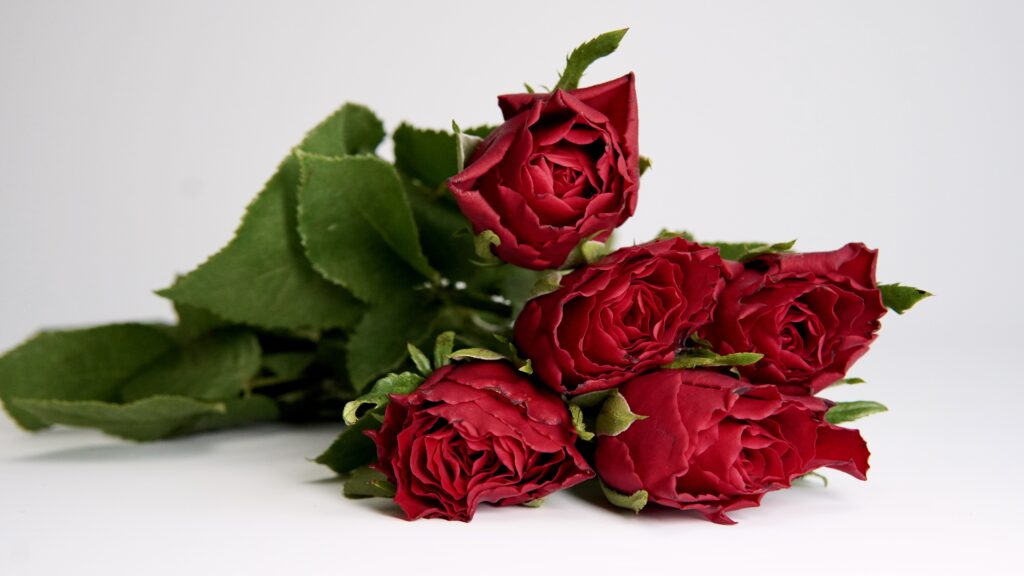
Let’s look more closely at red roses. White light falls on the petal, but our eyes see red. This happens because certain substances in the petal, called pigments, act like a filter.
Photo Copyright © G. Magnabosco
The colors that are filtered out are the complementary colors of red. You can find complementary colors on the color wheel: they sit opposite each other. Green is opposite red. (Extra knowledge: complementary color pairs make black in subtractive mixing and white in additive mixing. You can read more about color mixing in this excursus.
In our red rose, the pigments absorb the green wavelengths of light. You can see this in the reflection spectrum below: the green wavelengths have lower intensity than the red ones. That means the green light is absorbed and the red light is reflected – so the petals look red.
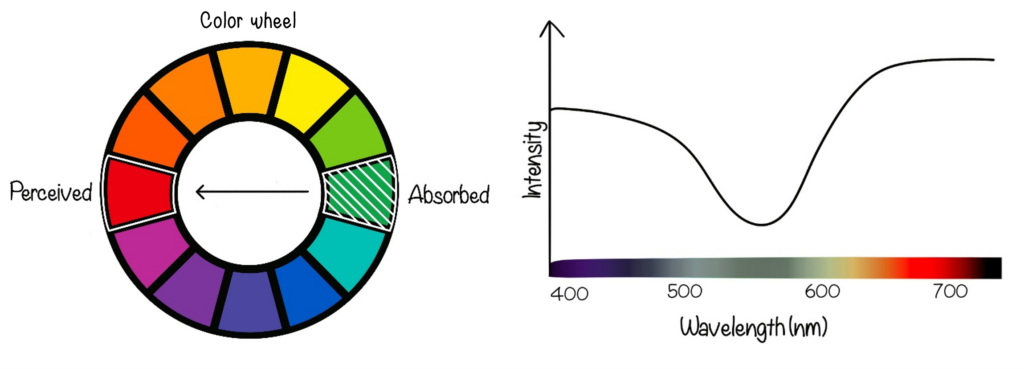
Color appears when the complementary colors are absorbed. That’s why these pigments and dyes are called absorption colors.
Absorption colorants are found everywhere in nature and are often also made synthetically. In nature, they fall into several chemical groups, for example:

Inorganic pigments: for example, iron oxides in rocks
Organometallic compounds: for example, chlorophyll in leaves, haemoglobin in red blood cells
Organic compounds: for example, carotenoids in carrots, indigo from the indigo plant
Watercolor experiment

We can extract the pigments from red rose petals and make our own watercolor. All you need is a bowl, hot water, and a few rose petals. Our video shows exactly how to do the experiment, and also how to make watercolor from red cabbage, turmeric, and coffee. Note: To watch the video with subtitles, follow the link.
Now we know that colors like the red of roses appear because the green part of the light is filtered out. But how do white and black appear? Do you have a guess? If so, write it in the comments.
White light contains all colors, so objects look white when all light waves are reflected. This is called scattering of light. In contrast, an object looks black when all the colors are absorbed.

Light-to-Heat Experiment
When an object absorbs light, it takes in energy, which we feel as warmth. We can test how much light is absorbed with a simple experiment!
Take two T‑shirts in different colors – ideally one black and one white – and place them in the sun. After a while, pick them up. Which one feels warmer? Tell us in the comments!


Result:
The black T‑shirt feels warmer because it absorbs all the colors of light. The white T‑shirt reflects them, so it absorbs less heat.
Application
Absorption colorants are found not only in nature; they are also used in industry to color your clothes or pens. We have already seen that sunlight can warm objects. But, sunlight can also make colors fade by breaking the chemical bonds in the molecules. This is similar to what happens to our skin when we get sunburnt. High‑energy ultraviolet (UV) light damages the molecules and, as a result, the material loses its color.

This is not only bad for dyed clothes; it can also be dangerous if, for example, road signs fade and become hard to see.
Photo Copyright © N. Vogel

That is why we need colors that never fade! In the next chapter, you will learn how and where you can find them.