
We’ve already learned that white sunlight can be split into separate colors. Each color represents a light wave with a certain wavelength. These color waves have wavelengths between about 400 and 800 nanometres (nm). A nanometre is very small – one billionth of a metre (1 m = 1,000,000,000 nm). Purple light has shorter wavelengths (around 400 nm), and red light has longer wavelengths (around 800 nm). The other colors lie in between. All these color waves that our eyes can see are called “visible light”.
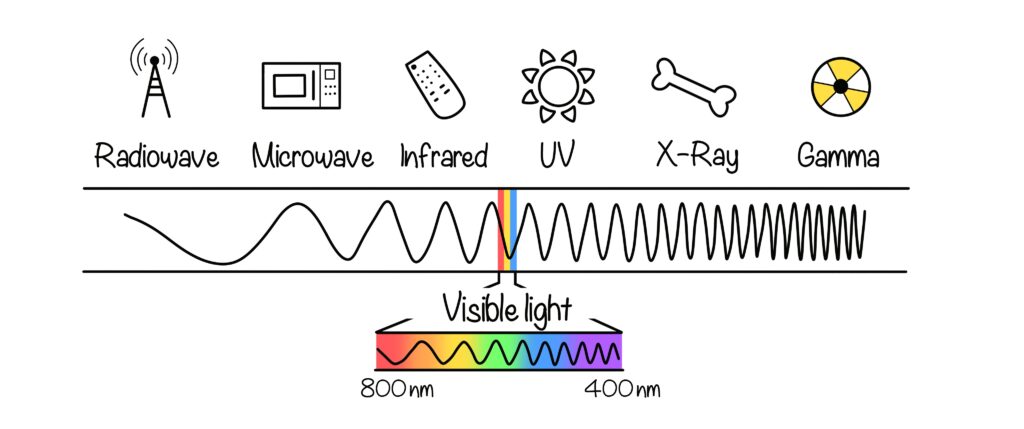
Besides visible light, there are light waves with much longer or much shorter wavelengths. Our eyes cannot see these. Waves longer than about 800 nanometres (nm) are called infrared light. We cannot see infrared light, but it carries heat. That’s why sunlight feels warm on your skin. Infrared light is also used in remote controls to send signals to your TV. With even longer wavelengths come microwaves, which heat our food, and radio waves, which we use to send music and to make calls on our mobile phones.
There are also light waves with wavelengths shorter than purple light (which we can just see at about 400 nm). These include ultraviolet (UV) light. The sun gives off UV light, which we cannot see, but it has a lot of energy. UV radiation can cause sunburn if you stay in the sun without protection for too long. At even shorter wavelengths are X‑rays, which help doctors look at bones, and gamma rays, a kind of radiation given off in some nuclear processes.

Different materials let some kinds of waves through, but block others. For example, during an X‑ray you wear a lead apron that blocks X‑rays to protect parts of your body, while the area being checked is left uncovered, so the X‑rays can pass through. Glass lets visible light through, which is why we use it for windows, but it absorbs much of the UV light and helps prevent sunburn indoors.
In science, light waves are also called electromagnetic waves. This name comes from the fact that they are made of electric and magnetic fields that vibrate at 90° angles to each other. When we talk about all possible light waves with different wavelengths, we call this “electromagnetic radiation”, or the “electromagnetic spectrum”.