

Imagine this scene: it’s the summer holidays and you’re sitting around a campfire with friends. You’re playing with colorful cards, and the sun is setting. As it gets darker, the colors become harder to see. Soon you can’t keep playing unless you use a torch or hold the cards in the firelight.
Conclusion:
So people can’t see colors without light. But why is that, and how do we see colors?
We need our eyes to detect light waves. Most parts of the eye are hidden inside the skull. Behind the pupil and the lens lies the eyeball, lined at the back with the retina. The retina has special cells, so-called receptors, that catch light and send signals to the brain. These receptors let us see the world. There are two kinds: cones and rods.
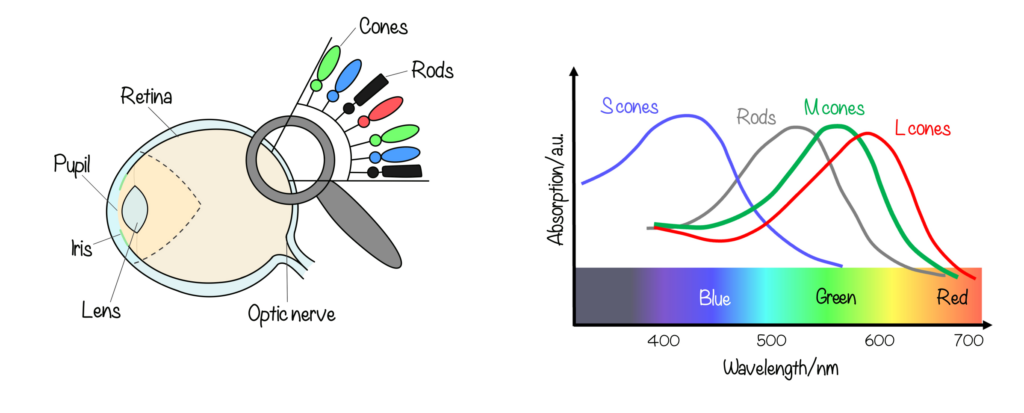
First, the cones. Cones let us see colors. There are three types: S-, M- and L-cones (often shown as blue, green and red). Each type is most sensitive to a certain range of light. You can see this in the spectra. A spectrum shows how much light of each wavelength is taken in. The higher the value, the more that cone responds at that wavelength. S‑cones respond most to blue light, M‑cones to green, and L‑cones to red. When light of different wavelengths enters the eye, more than one cone type can be active at the same time, and we see mixed colors from red, green and blue. Due to the cones we can see colors in bright light. Want to learn more about mixing colors? Check out this excursus.
Next, the rods. Rods respond to a wide range of wavelengths and are very sensitive in low light. They help us see at dusk. But because there is only one type of rod, we cannot tell colors apart in dim light, so everything looks grey. That’s why people say, “At night, all cats are grey.”13

Now you know how humans see colors. But what about animals, like our pets? If you’re curious, take a look at the excursus!