
In the last section, we learned about metal nanoparticles and their properties. Now we will look at another kind of colored nanoparticle, called quantum dots.
Quantum dots are extremely small particles, only a few nanometres across. They are made from materials called semiconductors, such as indium phosphide or zinc selenide. Unlike the plasmonic particles above, they only show their color when you shine high‑energy, short‑wavelength light on them, such as UV light. (see also Basics: Are There Other Kinds of Light?).

Why is that?
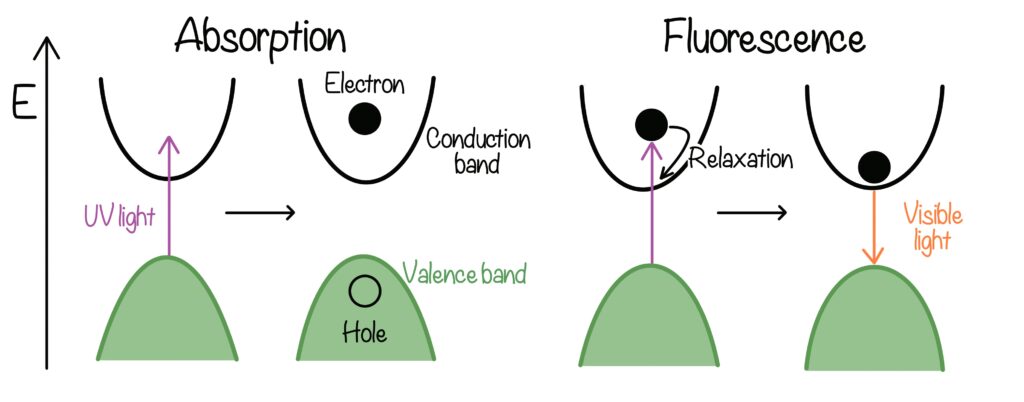
To understand it, we need to look at the electronic structure of semiconductor particles. You can imagine that semiconductors have two main energy “levels” where negatively charged electrons can be: the lower valence band and the upper conduction band – like two floors in a building. These two bands are separated. An electron in the lower band needs extra energy to “ride the lift” up to the higher band. When high‑energy light (usually with shorter wavelengths than visible light, i.e. ultraviolet) shines on a quantum dot, the light provides exactly this energy. Electrons are lifted from the valence band to the conduction band. We say the electrons are “excited” and now have higher energy. They don’t stay there for long. First, each excited electron settles to the lowest point within the upper band (this is called relaxation). Then it “falls” back down to the ground state in the lower band, giving back the extra energy as a flash of light. This process is called fluorescence.
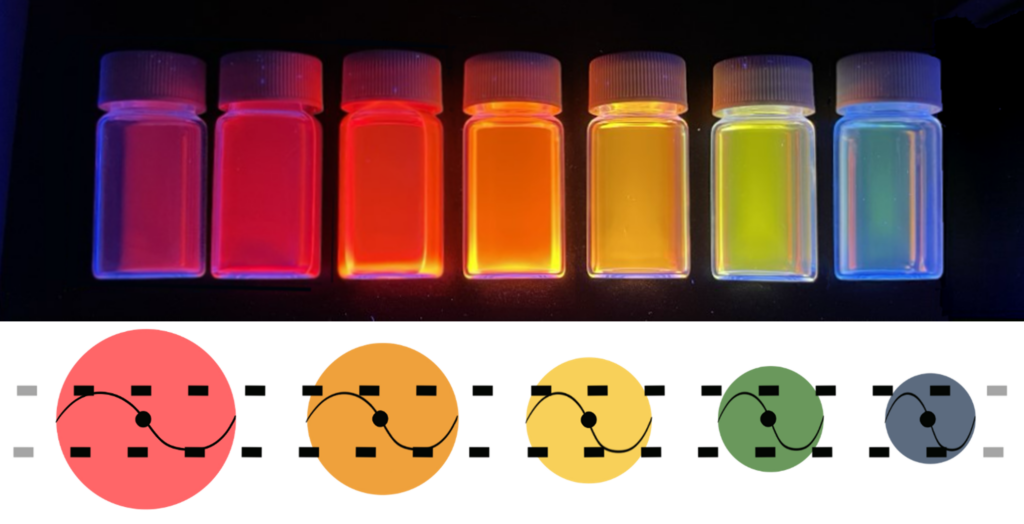
The energy (and therefore the color) of the emitted light depends on the size of the energy gap between the two bands. We can tune this gap by changing the size of the particles: larger quantum dots emit red light, smaller quantum dots emit blue light, and sizes in between give the other colors the rainbow.
Application

Quantum dots are already made in large amounts in industry. In 2023, the Nobel Prize in Chemistry was awarded for their discovery. Have you seen the words “quantum dot” or “quantum” before? Where? Tell us in the comments!

Did you think of an example? Quantum dots are used in modern QLED (Quantum LED) TVs to improve picture quality. This is because the colors from quantum dots are very pure. That makes it easier to mix precise colors and to target the cone cells in our eyes more accurately (see the excursus on how the human eye sees color). The result is a more true to life image.