
You’ve probably noticed this: during the day everything looks colorful, but at night the same objects appear only black and grey. This shows that we need light to see colors. Move the slider to switch the light “on and off”.
Photo Copyright © G. Magnabosco

But what exactly is light? Before you read on, take a moment: what does light mean to you? Which color does light have? Feel free to share your thoughts on the blog!
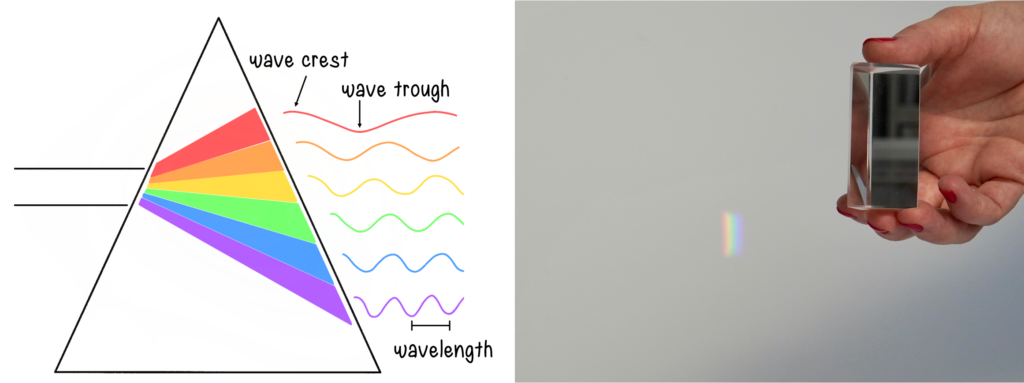
Visible light is the portion of the radiation from the sun that we can see. Sunlight looks white to us, but it contains all the colors of the rainbow. You can think of each color as a wave with a specific distance between two consecutive wave crests. This distance is called the wavelength.
When white light hits a glass prism, each color wave takes a slightly different path through the glass. As a result, the waves separate and we can see the individual colors.
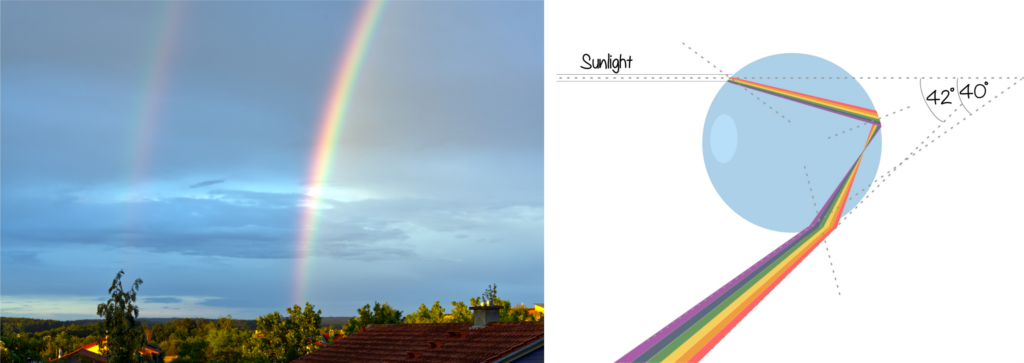
A rainbow in nature forms in a similar way. To see one, you need rain and sunshine at the same time. The sun should be behind you, and the rain clouds in front of you. When sunlight hits the outer edge of a raindrop, the light is reflected back towards you. The light waves are also bent as they pass through the drop: this is called refraction. Different colors are bent by different amounts: purple is bent the most (about 40°) and red the least (about 42°). This splits the white light into its colors, and you see a rainbow in the sky.

You can find a rainbow not only in the sky but also at home. Have you ever seen a rainbow in your home? If yes, tell us in the comments where you saw it.
Rainbow Experiment

It’s easy to make your own rainbow. Let’s try a few experiments! You will need: a prism, a glass of water, a CD, a candle, and a torch with white light (or sunlight). In our video, you can see how to do the experiments. Note: To watch the video with subtitles, follow the link.
For advanced learners: here is an explanation of how the rainbows in the video are formed.
When we shine white light through a prism or a glass of water, we can see a rainbow. White light is made of many colors. Inside the glass, each color moves at a slightly different speed, described by the refractive index. Because of this, each color bends a different amount. Colors that slow down bend more and colors that move faster bend less. This bending separates the colors apart and we see a rainbow. This bending is called refraction.
Next, let’s see what happens when we reflect candlelight from the back of a CD. Here, too, we can see the individual colors of the rainbow, but their arrangement changes. How does that work?
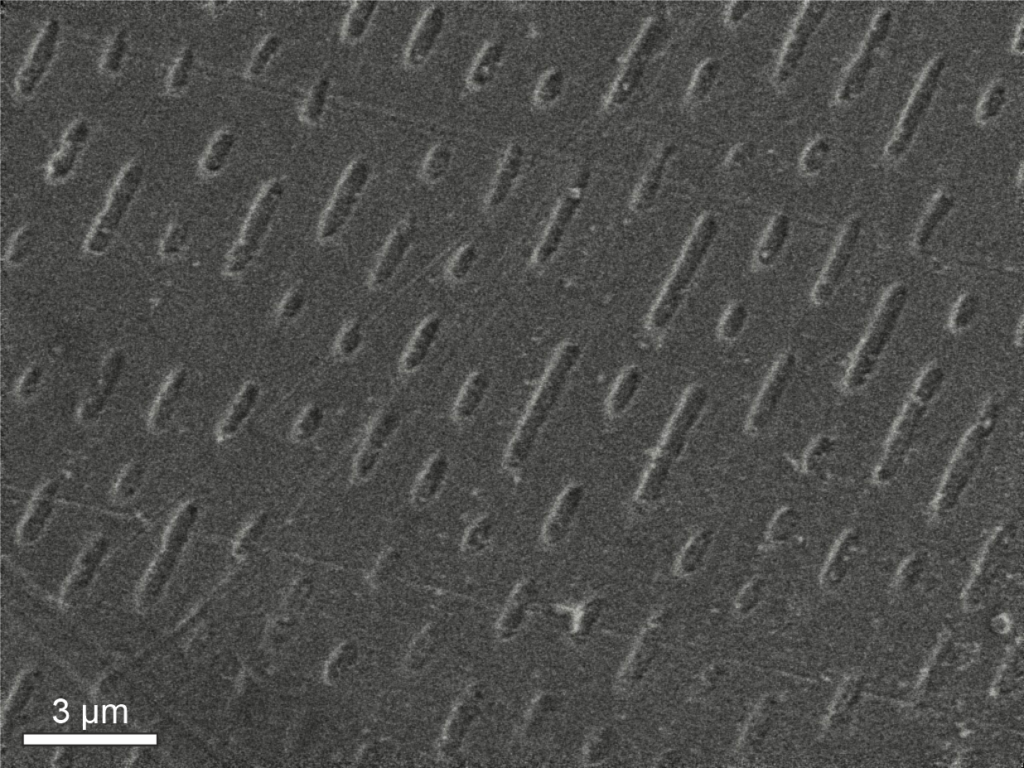
The back of a CD is covered with a spiral track. These tracks are very close together – only about 1.6 micrometres apart. At each track, the incoming white candlelight is reflected and split into its different color waves. As before, red light is bent less than blue or purple light.
Photo Copyright © G. Magnabosco
In addition, the reflected light waves can overlap. When two waves of the same wavelength, reflected from different places on the CD, meet, they can add up, partly cancel, or completely cancel each other. These three cases are:

- Two waves get stronger when their crests (or their troughs) line up. This is called constructive interference, and the color becomes more intense.
- Two waves cancel each other out when a crest meets a trough. This is called destructive interference, and we see no color.
- If two waves meet slightly out of step, their intensity is reduced, and we see only a faint color.
On the back of the CD, you see at any moment the colors whose reflected waves have added together (constructively interfered). This phenomenon is called diffraction. Because a candle flame flickers, the angle at which the light hits the CD keeps changing, and so does the angle at which it is reflected into your eye. As a result, the wavelengths that interfere constructively keep changing – and so do the colors you can see.
We have now learned that visible light is made up of all the colors. If you are curious about how our eyes perceive different colors and why we see only black and grey in the dark, take a look at this short excursus!