

We’ve already learned that some pigments fade, while others, like structural color pigments, can keep their original color. But there are more kinds of colors that do not fade. Can you think of any? Share your ideas in the comments.
One example is stained‑glass windows. Many old churches have beautifully colored windows whose colors have lasted for centuries. Ancient glass cups, such as the Lycurgus Cup, also still show a strong red color – even though the cup is almost 2,000 years old! But how does the color get into the glass? Do you have an idea? Write it in the comments.


Behind these brilliant colors are tiny particles of gold and silver embedded in the glass. These are called noble‑metal nanoparticles. Nanoparticles are extremely small – about a billionth of a metre, or one nanometre, in size. But where does the color of these metal particles come from? Let’s look at an example to find out.


We know gold as a shiny yellow metal used in jewellery. But if you make a piece of gold smaller and smaller – down to just a few nanometres – it can look red, like in the Lycurgus Cup.
To understand why, we need to look at the metal on the atomic scale. You can think of a metal nanoparticle as a fixed lattice of positive ions with freely moving negative electrons. Because these electrons can move, metals conduct electricity. When a light wave hits a gold nanoparticle, the electrons “feel” the rising and falling electric field of the wave. The field pushes and pulls the electrons so that they start to move back and forth – they oscillate. The speed of this motion (the frequency) depends on the color of the incoming light wave: shorter wavelengths (bluer light) drive faster motion, longer wavelengths (redder light) drive slower motion.
Each particle has a particular “natural” frequency at which its electrons oscillate most easily – like a guitar string that rings best at certain notes. When the wavelength of the incoming light matches this so-called Eigenfrequency, the electron motion becomes especially strong and the light is absorbed and scattered very strongly. This effect is called a plasmon resonance, which is why we speak of plasmonic colors.
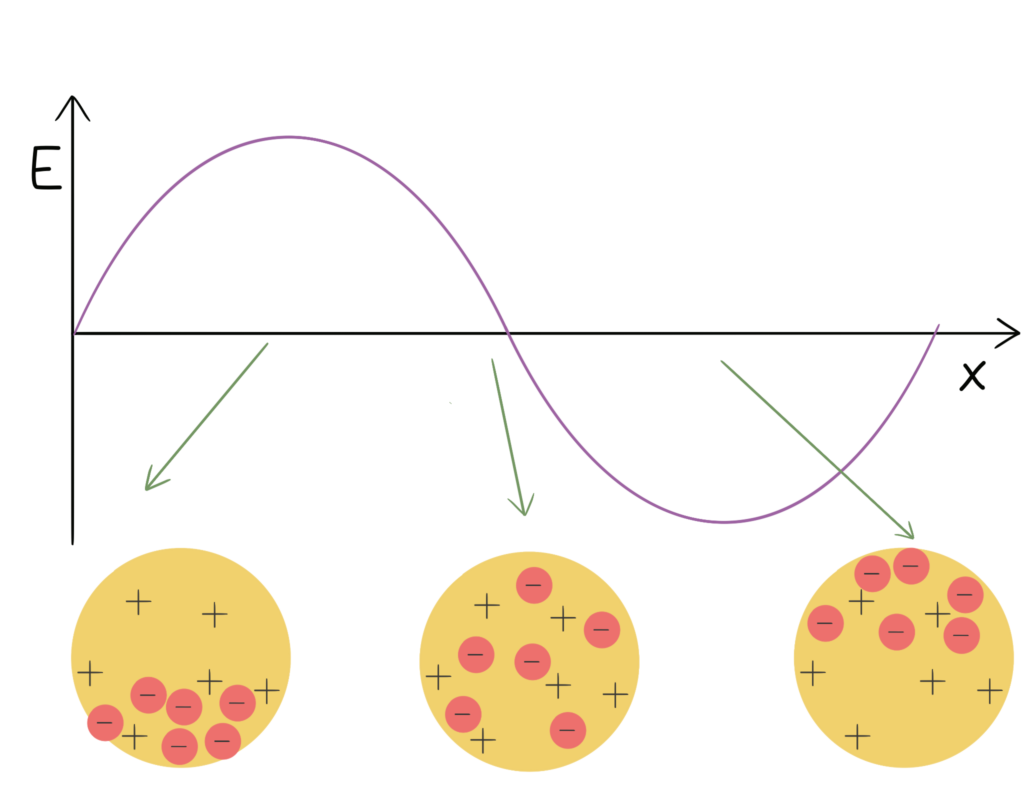
The Eigenfrequency of a nanoparticle depends on its size, shape and material. This is why different particles show different colors: at resonance, they absorb certain colors (wavelengths) more strongly. A gold nanosphere, for example, absorbs green light, so we see the remaining red light. Such gold particles are also embedded in the glass of the Lycurgus Cup and help give it its red color.
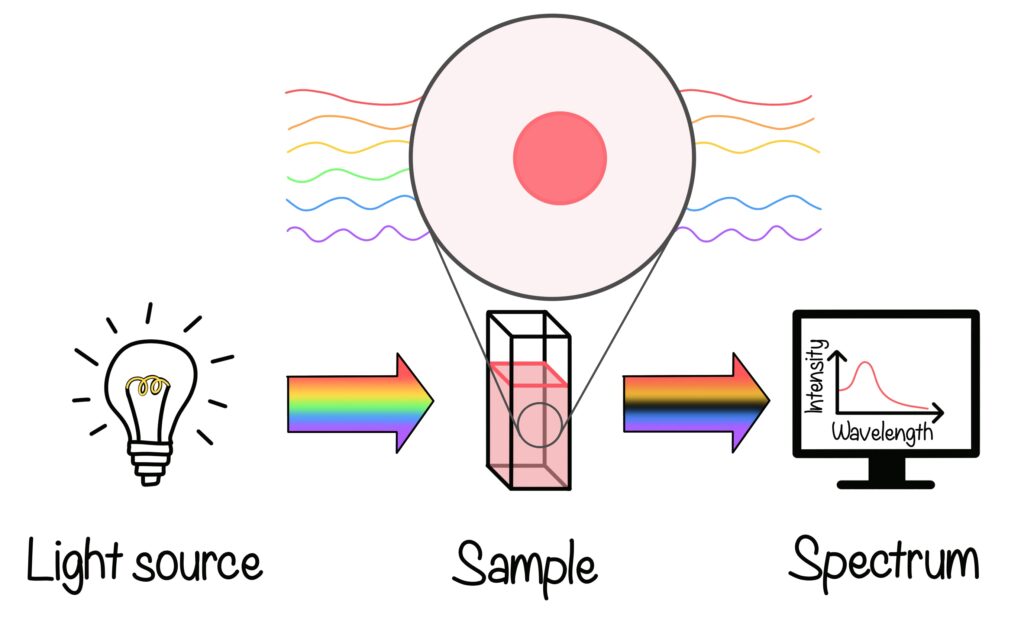
In science, we can measure which colors of light a particle absorbs. We use a spectrometer for this. It shines white light through a sample and measures which color waves pass through and which do not. The device then gives a spectrum that shows how much of each color is absorbed. For example, if we measure gold nanoparticles in water, the spectrum shows that green light is absorbed the strongest. Because green is the complementary color of red (for a more detailed explanation look at Chapter 2: Absorption Color), the gold nanoparticle solution looks red.
Task: Which color have the nanoparticles?
Here you can see different spectra of nanoparticles. Using what you’ve just learned, can you match each particle to its color?
Application
Gold nanoparticles are widely used in scientific research. For example, they are studied as tiny carriers that can deliver medicines to the exact place in the body where they are needed. Because they have a strong, easy‑to‑see color, they are also used in medical tests. Do you know where they are used? Tell us in the comments!

Did you guess it? The red lines in COVID rapid tests are made by gold nanoparticles. Antibodies are attached to the gold nanoparticles. These stick to set spots on the test strip (the C and T lines), depending on whether the test worked and whether the virus is present. Where the gold nanoparticles collect, a red line appears.
Photo Copyright © G. Magnabosco