
What are Gels?

Gels (more precisely hydrogels) are substances that are frequently found in medicine and cosmetics, in food, but also in nature. You know, for example, hair gel, raspberry jelly, jelly, or soft contact lenses. Examples of gels from nature are slime, fats, jellyfish, and the vitreous humor in the eye. At very high magnification (a light microscope is not sufficient), one can see that they are solids with pores filled with liquid, similar to a sponge, only that the pores are not visible to the naked eye. The liquid is held so firmly in the pores that it does not simply run out. And as with aerogel, the pores are interconnected, so that the solid and liquid penetrate each other.
Often, the term “gel” is associated with a wobbly consistency and a transparent or translucent appearance, like jelly or a jellyfish, but there are narrower and broader definitions.
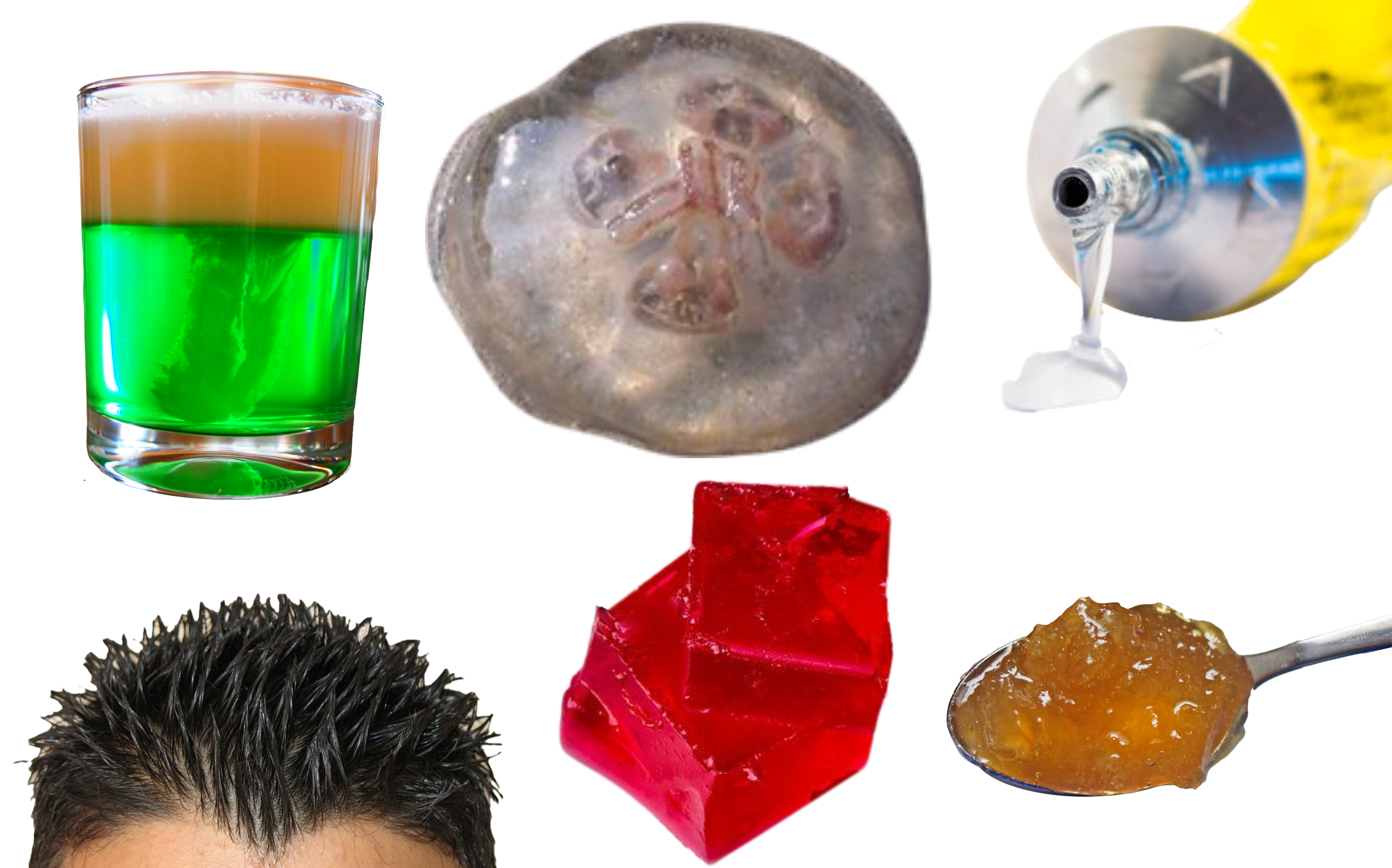
In a rather broad definition, which is suitable for the aerogels described here, fruits and vegetables, indeed all plants, can also be considered natural gels, as they also consist mainly of network-like solids in which liquids are bound. They are just more complex in structure because they contain cells that can already be seen under a light microscope, while gels in the narrower sense still belong to the realm of chemistry (or biochemistry) and consist of cross-linked molecules, e.g., carbon, silicon, or metal-based polymers, starch, protein, or fats.
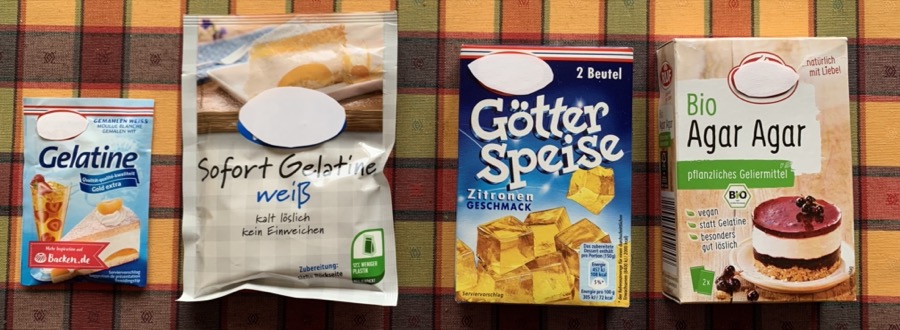
The image below shows gelling agents that can be used to make gels in the kitchen.
Task:
Gels belong to the so-called “heterogeneous mixtures”. This is how mixtures are described where it can be seen that they consist of several phases, which often also have different states of aggregation. Often, one phase is the main component and the second is finely dispersed in it, so “solid in liquid” (= the liquid phase is the main component, as in tea with floating tea leaves) is different from “liquid in solid” (= the solid phase is the main component, as in a wet sponge).