Hardware Overview
System

The ahoi modem consists of 3 components (stacked boards): mainboard, receiver and transmitter. The boards are connected with a 31-pin connector, sharing an SPI and I2C Bus, GPIOs, control signals, and the analog hydrophone signals. The hydrophone is connected to the transmitter board.
Hydrophone Connection
The hydrophone must be connected to the transmitter board; it must not be connected directly to the 31-pin connector lines.
Mainboard (MB)

The mainboard hosts the microcontroller (STM32F446RET), which performs the signal processing and controls the other boards. All circuitry of the modem is powered by a single 12V supply, which must be connected to the mainboard by the corresponding connector. This connector features a polarity protection.
The microcontroller and all logic use a 3.3V DC supply, which is generated on-board by a dedicated, low-noise DCDC converter. This 3.3V rail is fed to the 31-pin connector and is used by the other boards.
A serial and control port is available via pin headers and on the 17-pin connector. These lines are isolated and require an external power supply. We recommend a 3.3V supply and 3.3V logic levels; however, the isolator has a maximum rating of 5.5V. The two control lines are reserved for future use. The serial line enables communication with the modem for configuration purposes and packet sending and receiving. The modem can also be programmed via the serial line.
The 17-pin connector exposes the lines for programming the modem via an STM programmer (ST-LINK/v2). These lines are protected by resistors only. Please note that you must not connect an external power supply to this 17-pin connector.
Finally, six LEDs indicate the status of the modem.
Receiver (RX)
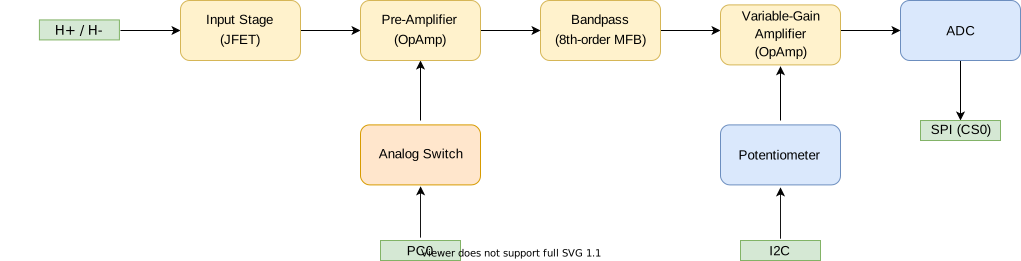
The receiver board acquires the analog signal from the corresponding lines of the 31-pin connector and feeds it through the following analog stages:
- Biasing and light amplification based on a low-noise, low-power JFET. The input impedance must be adjusted to the hydrophone in use.
- Pre-amplification with an optional circuitry for a software-switchable, reduced gain in noisy environments.
- Bandpass filter to remove noise and lightly amplify the signal. This stage relies on precise components (1%) and requires adaption of the pass band based on the used frequency band.
- Software-controlled variable gain stage with 18 gain levels in steps of 2 dB.
- ADC
The bandpass has a bandwidth of 50 kHz. Its center frequency can be adjusted via 8 capacitors (named CBP). Per-stage and overall gain is summarized in the following table.
| input | pre-amp | bandpass | amplifier | total | |
|---|---|---|---|---|---|
| gain (dB) | 17 | 35 / (17) | 3dB | 3, 5, ..., 39 | 40 - 94 |
The receiver features its own 5V analog supply to suppress digital circuit noise via a DCDC step-down converter followed by an LDO. The former is supplied by the 12V line from the mainbaord. All logic levels on the receiver are 3.3V, powered from the digital/IO bus.
The receiver is enabled via line RX_EN by the microcontroller. Its typical power consumption is 100 mW in active mode. Line PC0 is used to control the pre-amp gain reduction (low: full gain, high: -18 dB). The amplifier is controlled via I2C and the ADC is controlled by the microcontroller and connected via SPI (CS0).
Transmitter (TX/TXB)
The transmitter of the ahoi modem comes in two flavors: a low-power transmitter (TX) and a high-power transmitter (TXB). The default setup is to use TXB.

The structure of both variants is equal, differences are in the power supply and the power amplifier topology and ICs.
The analog signal is generated by a DAC and fed through a 4th-order low-pass reconstruction filter. Aftwerwards, the signal passes an attenuation stage, which is controlled by the microcontroller in 11 steps of -3 dB from 0 dB to -30 dB. A power amplifier boosts the signal level and drives the hydrophone.
The TXB provides a +/-22 V supply and produces an output signal of +/-40 V amplitude via a bridge amplifier topology. The maximum output current is 200 mA; we recommend a peak maximum of 100 mA to prevent damage from overheating. The TX provides a +/-18 V supply via a low-power charge pump and produces an output signal of +/-17.5 V amplitude via a single op-amp. The maximum peak output current is limited to ca. 40 mA.
Both boards host the hydrophone connector and a signal switch to connect the hydrophone either to the transmit output circuitry or the receiver (via the lines H+ and H- on the 31-pin connector). The hydrophone is connected to the transmit output circuitry, if the transmitter is enabled (via line TX_EN) and line SW_TXRX is logic high. Otherwise, the hydrophone is connected to the receiver (via the 31-pin connector). The behavior of both lines is software-controlled. The transmitter is only enabled for transmission and powered off otherwise with negligible consumption. Idle consumption, when the transmitter is on but not sending, is ca. 300 mW for TX and 800 mW for TXB.
The DAC interfaces with the microcontroller via SPI (CS1). Transmit output levels are selected by software via I2C.
Bug
Versions 5.0 to 7.0 of TXB have a hardware bug that needs to be fixed, please refer to Errata.
Programming board
The programming board attaches to both connectors at the mainboard and contains an SWD connector and pin headers for the signal pins. The boards is mainly used for fast programming via an ST-LINK/v2 programmer. It can also be used for debugging, because all lines of the 31-pin connector are available via pin headers. For programming, a separate 12V supply is required to power the mainboard. The available supply of the programmer is not connected. Note that you should not connect a 12V power supply to the programming board: this will bypass the protection circuit; use the connector on the mainboard instead.
Debug board
Since the programming board blocks easy access to the top side of the connected PCB, we developed a debug board. It has only one 31-pin connector and is mounted in a way that gives access to the entire connected PCB. It exposes all lines of the 31-pin header, provides a standalone 3.3V supply, and several LEDs. The 3.3V supply is required only when connecting an RX or TX(B) board for debugging or testing purposes.
Danger
- When you connect the debug board to an MB, you should not connect a 12V power supply to the programming board: this will bypass the protection circuit; use the connector on the mainboard instead! You must also disconnect the 3.3V supply of the debug board by removing its jumper!
- When you connect the debug board to an RX or TX(B), you have to connect the 12V supply to the debug board 12V and GND pins. Be aware that the debug board has no polarity protection!