
Energy-Efficiency in Embedded Systems (EEE)
Lecturer: Ulf Kulau Lucas Bublitz Tim Lühnen
Lecture: Tuesday 11:30-13:00 Room A-1.16
Exercise: Friday 09:45-11:15 Room D-1.024
Kick-Off: Tuesday 20.10.2026 11:30 in Room A-1.16 StudIP-Link: EEE in StudIP)
Modul:
- Master "Computer Science (CSMS)": Vertiefung I. Computer- und Software-Engineering (6 LP)
- Master "Elektrotechnik (ETMS)": Vertiefung Nanoelektronik und Mikrosystemtechnik (6LP)
- Master "Microelectronics and Microsystems (IMPMM)": Vertiefung Embedded Systems (6LP)
- All other Master Programs can use the Modul "Technischer Ergänzungkurs" to credit the course

Language
Course is available in german and english.
Registration
Anmeldeverfahren / Registration:
- Pre-Registration for the course is only possible via StudIP
- The event is limited to a maximum of 25 places!
- Pre-Registration is possible from TBD to TBD
- !!! We have limited places in this event !!!
- All pre-registered students will take an online test on 07.10.2026 17:00. Only after the test 25 students will be selected for the course
- The reason for the limitation is, that the Course offers a PBL with limited HW Boards to work on
- Important Note: Without performing the PBL you won't be allowed to finish the course (required for taking the exam)
Content
In the field of computer science, we have only limited possibilities to influence the efficiency of the hardware directly, or we are dependent on the manufacturers (e.g. of microcontrollers). However, in order to exploit the full potential of the hardware provided to us at the system level, we need a deeper understanding of the background, processes and mechanisms of power dissipation in embedded systems. Where does the power dissipation come from, what happens at the hardware level, what mechanisms can I use directly/indirectly, what is the tradeoff between flexibility and efficiency,.... are only some questions, which will be worked out and discussed in this course. In the lecture and the corresponding exercise the following contents will be taught:
- Motivation and power dissipation of semiconductors
- Power dissipation of digital circuits
- CMOS and its power consumption
- Power management in hardware and software (sleep modes, DVS, FS, undervolting)
- Energy efficient system design (applications)
- Energy Harvesting and Transiently Powered Computing (TPC)
The course is complemented by a project-based exercise in which aspects learned on an energy harvesting platform (AVR microcontroller) are put into practice.
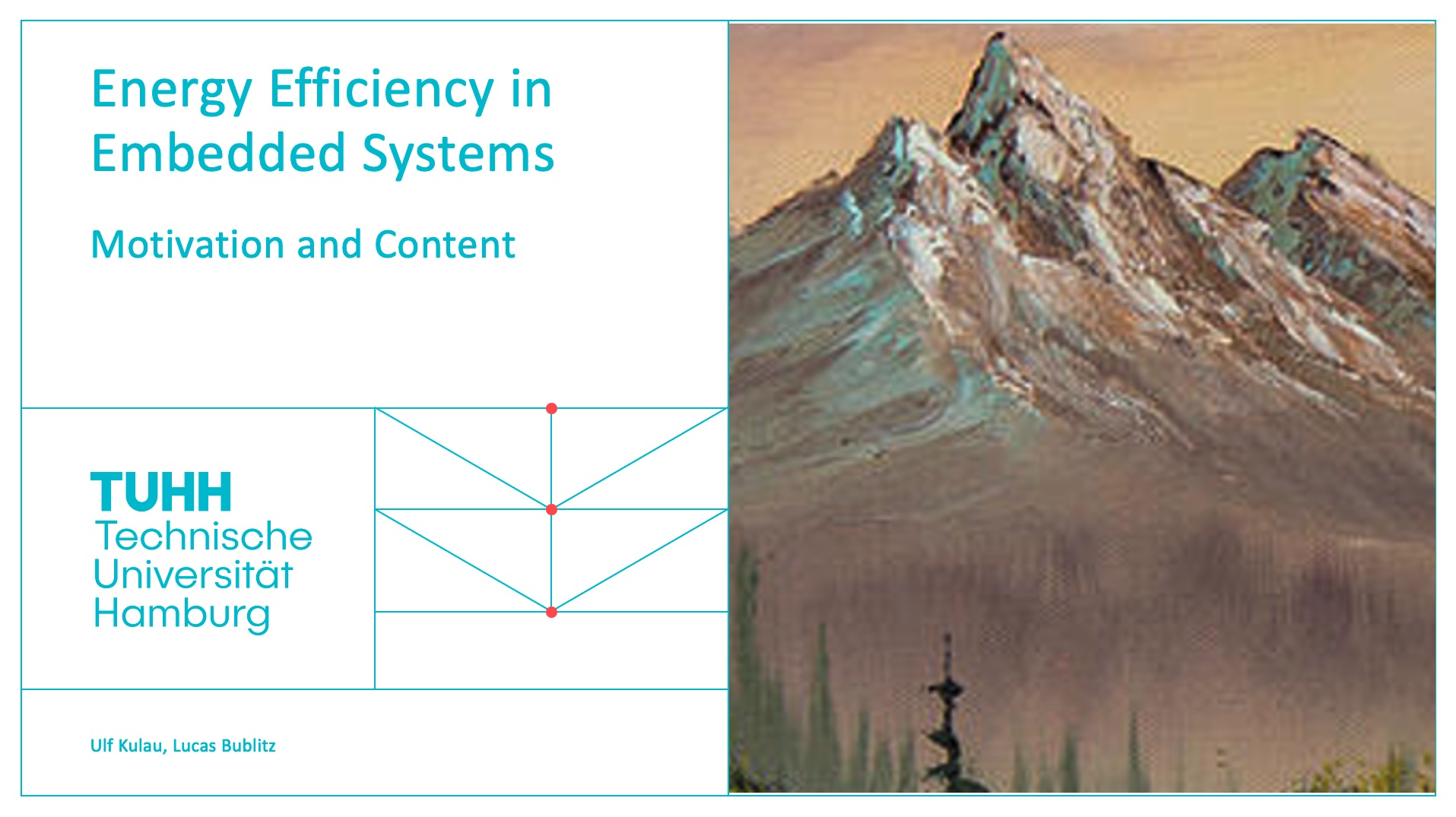
- A Motivation and an Overview of Contents is also provided in the following Slides:
Prerequisite
- Computer engineering (necessary)
- Programming skills in C (required)
- Computer architectures (recommended)
- High motivation and interest in the subject
Literature
The course is based on a variety of different sources. To provide a better overview, all sources are summarized in the paper Course: Energy Efficiency in Embedded Systems – A System-Level Perspective for Computer Scientists.
-
EWME
Conference
Course: Energy Efficiency in Embedded Systems – A System-Level Perspective for Computer Scientists -
12th European Workshop on Microelectronics Education (EWME), 20182018.
10.1109/EWME.2018.8629441 [BibTex]
- Low power design essentials
-
Springer Science & Business Media2009.
[BibTex]
- Cmos vlsi design
-
ed: Pearson Education, Inc2010.
[BibTex]
Evaluation
- Evaluation results will be made public here