


The CubeSat LAB
provides students interested in space with an opportunity to work on a real satellite and its payload development and operation. Furthermore, it is an extension of the lecture 'Grundlagen Raumfahrtelektronik und Primärmission' for students who wish to expand their knowledge of space.
Hamburg Space Team at CubeSat LAB
The CubeSat LAB is the place where students at TU Hamburg can get hands-on experience with space technology. It connects teaching and research with practical engineering and provides the environment in which students can work on real space hardware.
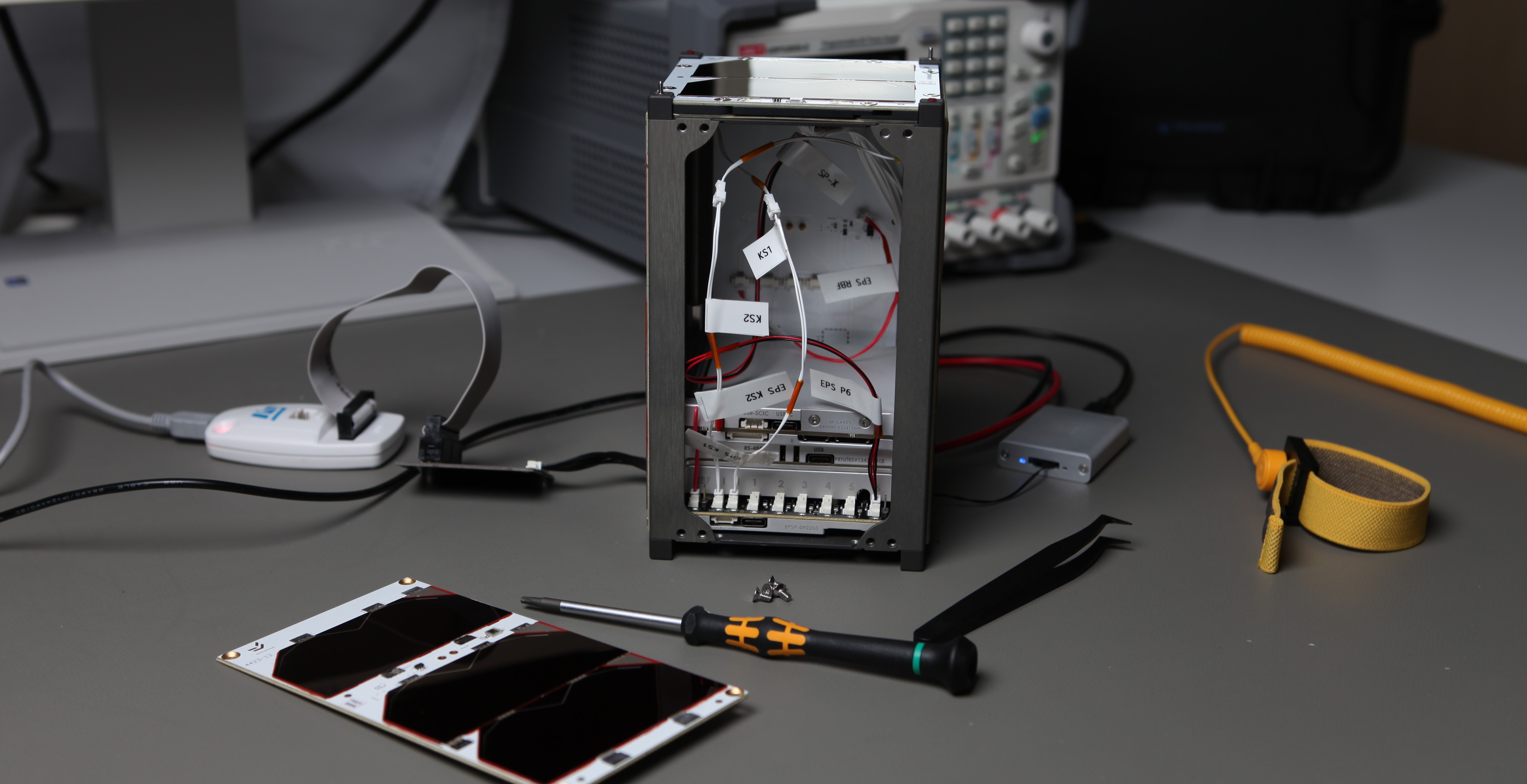
Out of this environment, the student satellite initiative THHOR emerged. Today, THHOR forms the orbital branch of the Hamburg Space Team, connecting the original CubeSat activities with a broader student aerospace organisation.
The Hamburg Space Team e.V. brings together students working on different aspects of aerospace engineering — from satellites and avionics to rockets, payloads and experimental systems. The team is therefore not tied to a single mission or project. Instead, it provides a framework in which new projects can emerge, while experience and infrastructure can be shared between them.

From research to flight hardware
The connection between the Smart Sensors Group, the CubeSat LAB and the Hamburg Space Team creates a continuous environment for space-related work at TU Hamburg.
The Smart Sensors Group provides the research environment and expertise in areas such as sensors, electronics, embedded systems and optical technologies. The CubeSat LAB builds on this environment and gives students the opportunity to apply this knowledge to satellite development. The Hamburg Space Team extends this approach beyond a single satellite and provides a student organisation in which these skills can be used across different aerospace projects.
This makes the CubeSat LAB more than just a place to work on one CubeSat. It is a starting point for students who want to get involved in space engineering and become part of a larger community:
Smart Sensors Group → CubeSat LAB → Hamburg Space Team
Within this ecosystem, students can move from lectures and research projects into hands-on development, take responsibility for subsystems and eventually work on hardware designed to leave the laboratory and operate in a real environment.
Projects that keep evolving
The work of the Hamburg Space Team is organised around projects rather than a fixed list of tasks. Some projects are currently being developed, others are being tested or operated, and new ideas are continuously added.
The orbital activities of the team are organised through THHOR and build on the work started in the CubeSat LAB. The first satellite mission, HANS, focuses on observing auroras and processing the acquired data onboard. At the same time, other projects explore completely different areas of aerospace engineering, such as optical communication, high-altitude experiments and rocket technology.
This allows students to work on very different systems while sharing knowledge, infrastructure and experience. A new project does not have to start from scratch: electronics, software, testing methods, documentation and lessons learned from previous projects can become the foundation for the next one.
For more information about the individual projects and their current status, see the Hamburg Space Team website.
Join the team
The Hamburg Space Team is student-led and interdisciplinary. You do not need to already be an aerospace expert to get involved. Students from electrical engineering, computer science, mechanical engineering and many other backgrounds can contribute their knowledge and learn from each other.
There are opportunities to work on electronics and PCB design, embedded software, sensors and payloads, mechanical systems, simulations, testing, ground infrastructure, mission operations and many other areas.
The important part is not which project is currently active, but the opportunity to build something together, learn from real engineering challenges and pass that knowledge on to the next generation of students.
The CubeSat LAB remains one of the places where this work happens — connecting the Hamburg Space Team to the research and teaching environment of the Smart Sensors Group and TU Hamburg.
Check out the Hamburg Space Team website for information on how to join.
Contact persons





Project Funding
The CubeSat LAB plays a fundamental role in the innovative way of teaching which is the key field of the EduSat research project. The EduSat research is funded by Stiftung Innovation in der Hochschullehre as part of the call for proposals Freiraum 2023 under project number FR-113/2023.