
Manufacturing Step 1: Gelation
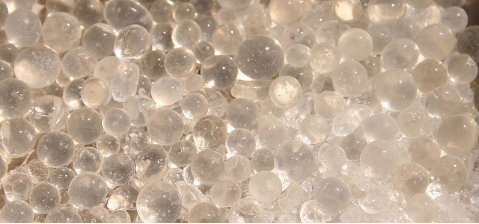
Source, License CC BY-SA 2.5
In the first step, a hydrogel is produced (see Figures 1 and 2). Smaller building blocks crosslink to form longer chains, as can be seen in the graphic below: The pores formed are the cavities between these chains, which are filled with water.
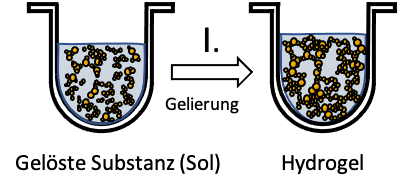
If, for example, you heat jelly powder with water and then cool it down, a gel forms, resulting in solid jelly. The same happens when cooking jam or jelly.
Gelation in the manufacturing process of aerogels proceeds in the same way or slightly differently depending on the starting material. It can be triggered by heating, by changing the pH value, or by adding metal ions (e.g., calcium ions). You can see this last mechanism in the video on the production of an alginate aerogel:
Interactive Video: Production of an Alginate Gel

Task:
Did you pay attention during the video? Then you should be able to answer the following questions. If not, you can rewind.
Would you like to know why it’s called the “egg carton mechanism”? Take a look at the excursion below.