

Welcome back!
Did you carry out the experiment with the colored felt-tip pen colors? Then you can now answer the questions in our puzzle.
If you haven’t done the experiment, you can watch the film about the color migration of felt-tip pen colors and still answer the questions.
What can you observe in this video of our experiment? Were there differences in the separation between the different felt-tip pen colors? What colors are the felt-tip pen colors made of? Which color migrated the fastest, which the slowest?
If you did the experiment: Did you make similar or different observations? Into what colors did your different felt-tip pen colors separate? Which of your felt-tip pen colors migrated the fastest? You are also welcome to compare felt-tip pen colors from different brands. Write to us in the blog.
In the video, you can see that the lines of the felt-tip pen colors on the filter paper have changed: If you draw on filter paper with a felt-tip pen and place one end in a liquid, the liquid moves through the paper due to capillary forces, partly carrying the dyes from the felt-tip pen with it. (This also works without a paper roll as a wick, by simply hanging a strip of paper with color dots in the liquid.)
The following can be observed:
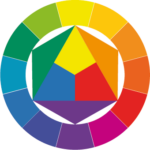
(Source: https://upload.wikimedia.org/wikipedia/
commons/8/88/Farbkreis_Itten_1961.png)
Blue, yellow, and red are primary colors (so-called primary colors in the color circle), which is why they are not separated at all, meaning they are pure substances (This applies primarily to red and yellow). Although blue is also a primary color, some blue felt-tip pen colors are mixtures, as can be seen in the video, and are therefore separated into their components.
Black and green, for example, are secondary colors (so-called secondary colors in the color circle), meaning they are mixtures of many different color components – they are composed of the primary colors blue, yellow, and red.
Why can the individual dyes be recognized separately after chromatography?
The colors we see are the parts of the light spectrum that are reflected by a substance, meaning they are not absorbed. The so-called subtractive color mixing occurs when certain parts of the light spectrum are removed, i.e., subtracted, because they are not reflected. Black, for example, appears to us as something that absorbs almost all colors and reflects (almost) no colors.
The primary colorants (pure substances) are not converted into a new colorant when mixed, but overlap in the mixed color (in the mixture), so that we see the mixed color. In paper chromatography, it is shown that the color particles have different strengths of interactions with the stationary phase, which is why they stick (adhere) at different points on the filter paper. This is why the dye mixtures can then be separated back into the primary colors (pure substances).
What types of color mixing are there?
Colors can be created by adding another color to a color. In televisions or computer screens, colors are produced by colored light points or light sources that only exist in red, blue, and green. These light sources reinforce each other when they meet, meaning the intensity of the light points adds up. This is called additive color mixing. Blue and green together produce cyan, red and blue light together produce magenta, and red and green together produce yellow. Adding all three colors results in white. With additive color mixing, different colors can be produced depending on the mixing ratio.
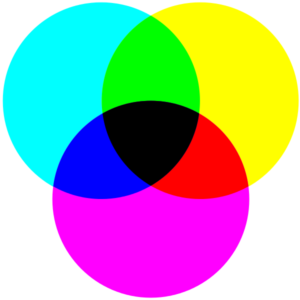
In printers, colored pencils, or paint boxes, colors are produced from pigments that do not glow themselves. Here too, different colors can be produced by mixing magenta, cyan, and yellow, but they do not become more intense, but darker. This means the intensity becomes weaker when they are mixed. This is called subtractive color mixing: In subtractive color mixing, parts of the light are absorbed and thus subtracted from the originally present light. The remaining light forms a mixed color from the primary colors magenta, cyan, and yellow upon superposition. Magenta and yellow produce red, cyan and yellow produce green, and magenta and cyan produce blue. Mixing all three colors results in black. (However, black is usually added separately in printers because the mixture of the three colors is not strong enough.)
How does the separation occur?
The separation of felt-tip pen colors works very well with water, but not with oil. This is related to the water solubility of the felt-tip pen colors and the polarity of the mobile phase and the mixtures (mixed colors). The dyes interact with the mobile phase water (or oil) and the stationary phase, the paper.
The mobile phase water has a very high polarity. Colors that also have higher polarity dissolve well in polar water according to the principle “like dissolves like”. The higher polarity thus causes the individual color components (molecules) to be transported further with the mobile phase water. Color molecules with lower polarity do not migrate as far and adhere more strongly to the stationary phase, the filter paper. This results in the separation into color stripes.
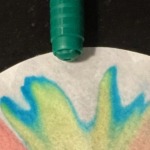
As an example, we can consider the green felt-tip pen color: Yellow has lower polarity than blue, therefore dissolves less well in water than blue, and does not migrate as far: The yellow color components of the green felt-tip pen color are closer to the center on the chromatogram, while the blue color components have migrated further to the edge. Thus, we can separate the green felt-tip pen color into its components because the individual components have different polarities.
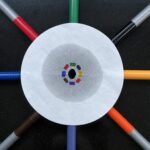
In contrast to highly polar water, the mobile phase oil is nonpolar. The polar molecules of the water-soluble felt-tip pen colors therefore do not dissolve in oil, as you can see in the video above.

Did you understand everything? Then you can surely drag the correct words into the gaps!
Good luck!