
What is HPLC?
Hey, nice to see you again. Are you ready for the next part of the mission? Let’s go!
The separation method that we carried out on a small scale with paper or chalk is applied on a large scale in industry.
This requires larger devices that can process larger sample quantities. One of these devices is the HPLC system.
In this film, you will learn what HPLC means and how this device works for substance separation and analysis.

Blog task:
Did you understand everything? Then you can surely answer the following question:
Why do some components*, here the acid, reach the detector faster than others? (*A component is a constituent of a mixture. Go to Mission II over Mixtures if you want to look at this in more detail.)
Write your solution in the community.
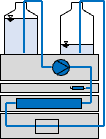
HPLC, or High-Performance Liquid Chromatography, is therefore an analytical method based on a chromatographic separation process at high pressure in a column.
In HPLC, too, a sample (a mixture of different components) is dissolved in a mobile phase (mobile phase) and transported over a stationary phase – a solid, finely porous carrier material in the separation column.
The sample is injected into the mobile phase via an injector.
The detector at the end of the separation column makes the separation measurable and visible by converting the information into electrical signals, which are output by a computer in a chromatogram.
Now you have learned quite a bit about a high-pressure liquid chromatography device. Can you assign the terms in the image to the correct parts of the HPLC system?
In the second part on HPLC, you will get more details about the HPLC process.