

Welcome back!
Did you find any examples of chromatography in everyday life?
If not: Chromatography is used in a wide variety of fields to separate mixtures of substances into their components. If you are interested in application areas of chromatography, click here to go to the excursion on application areas.
Chromatography is a physicochemical separation process that separates liquid and gaseous mixtures of substances into their components based on different migration speeds.
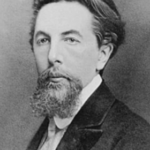
The process was discovered in 1903 by the Russian botanist Mikhail Semyonovich Tsvet.
A botanist studies the structure and types of plants. Mikhail Semyonovich Tsvet discovered in experiments that the green leaf pigment consists not only of green color but of several pigments. He named the process he used in his experiments “chromatography.” (Chromatography can be spelled with “ph” or “f”.)
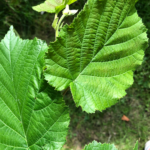

The term chromatography is derived from the Greek words xρώμα (“chroma” = color) and γράφειν (“graphein” = to write), meaning “color writing.” How did Tsvet “write” with colors? You can learn more about this here in our mission on the chromatography of leaf pigments.
Simply put, the principle of chromatography can be imagined like a river carrying sand or stones as driftwood (= sample or mixture to be separated). Depending on the flow speed of the water (= eluent or mobile phase) and the nature of the driftwood (small or large, light or heavy), the driftwood is transported at different speeds over the different surfaces of a riverbed (= stationary phase). On a rougher surface, friction increases and the transport speed of the driftwood decreases. The current quickly washes fine, light sand far away, while coarser stones are only slowly washed further due to their weight.
In other words: In chromatography, different components of a mixture of substances (= driftwood) are transported in the mobile mobile phase (= water) on a stationary phase (= riverbed) and retained there by different influences.
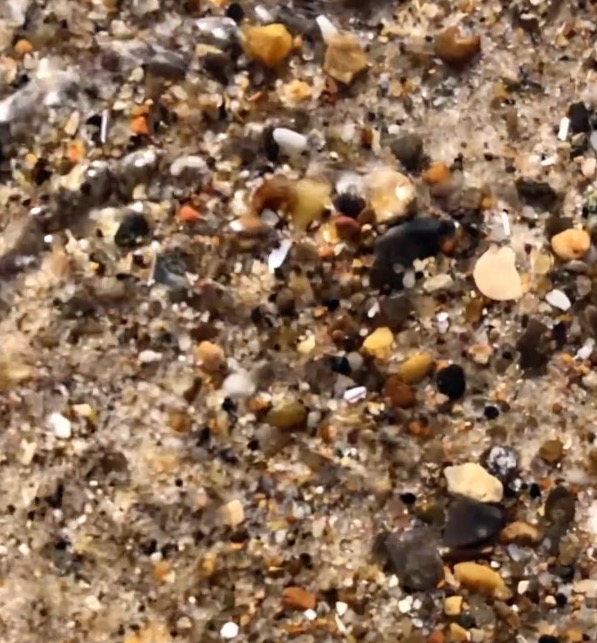
To illustrate, let’s look at a riverbed. Click on the screenshot to go to the film!
In other words: The sample mixture (mixture of substances) interacts with the mobile phase and the stationary phase. Here you can see the riverbed diagram and the basic diagram of chromatography in direct comparison. Slide the slider from left to right!

Task:
Now you have learned a lot about the comparison between the basic scheme of chromatography and a riverbed.
You can test your knowledge in the blog task!
Good luck!