
In addition to drinking milk as a beverage, it can be used to make a wide variety of products—from butter and yogurt to cheese. It’s hard to imagine supermarket shelves without them. But how are these products actually made?
How are dairy products manufactured?
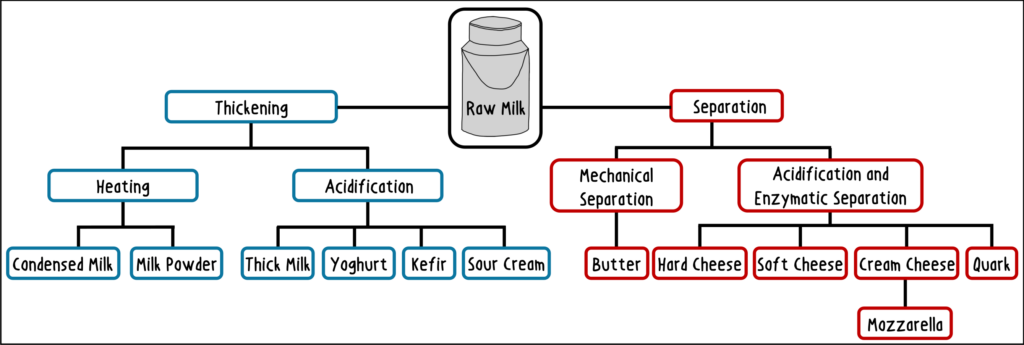
The special thing about milk is that you can make many different foods from it without using many additional ingredients. What matters is how the components of milk are altered, combined, or separated. As a result, different tastes and consistencies emerge (picture 3). One possibility is to separate fat and liquid mechanically by stirring. If you stir cream for a long time, the fat particles will glue together, and the result is butter. What remains is buttermilk, the liquid part. Stirring breaks down the protective layer surrounding the fat droplets, causing the fat to clump together. Another method is to thicken milk by reducing water through heating. This is the way how condensed milk develops. By reducing almost the whole amount of water, you get powdered milk. To produce not just a thickened dairy product but also to alter its flavor, the milk can be soured. Hereby, lactic acid bacteria metabolize lactose into acid. The milk proteins gradually accumulate, causing the milk to thicken slowly—at first, without the solid and liquid components separating clearly. Thus, products like yoghurt, thick milk, kefir, or sour cream develop. However, for many types of cheese, the milk must be thickened to the point where the proteins clump together completely and separate from the liquid part of the milk. This process is called coagulation. The solid part is the cheese curd, the liquid one the whey. If you let soured milk sit long enough or add large amounts of acid, this type of coagulation occurs. However, acid coagulation takes a long time, and both the curds and the whey taste sour. Therefore, rennet (an enzyme mix) is used; it separates milk quickly and gives cheese a mild taste.
The next paragraph tells you in detail how this works. However, for the rennet to work effectively, the milk still needs to be slightly acidified by lactic acid bacteria. Today, for most types of cheese, the milk is first acidified and then curdled using rennet. But why do the proteins clump together during cheese production?
What role does the protein casein play in the production of dairy products?
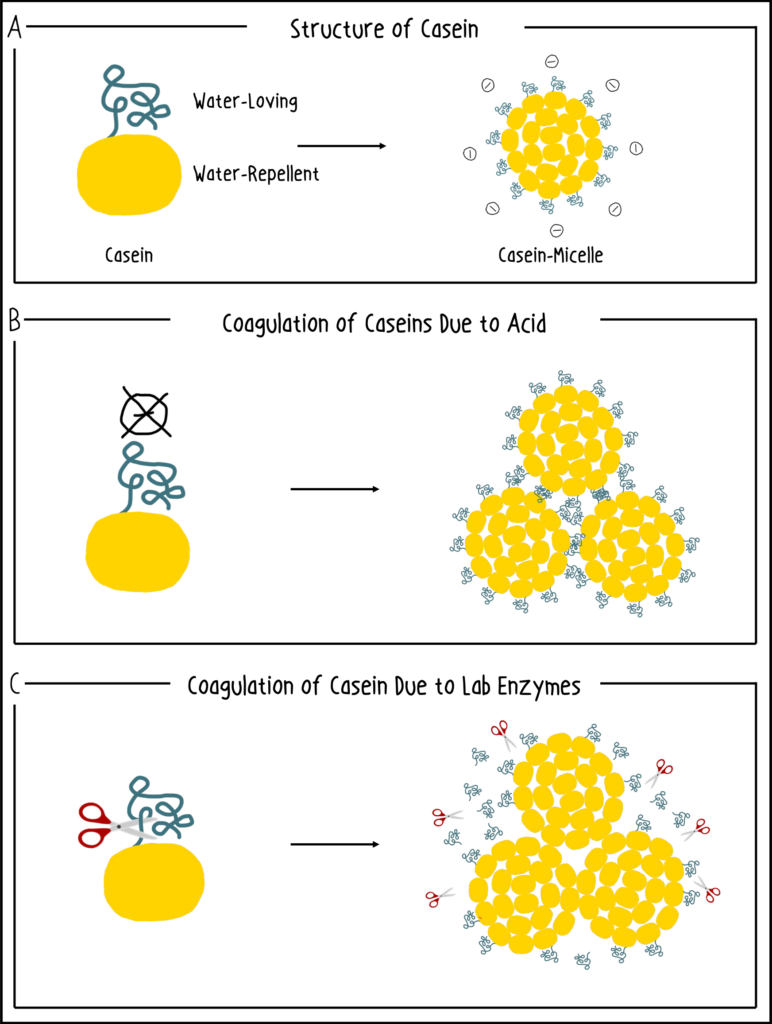
To understand why proteins, clump together during the production of many dairy products, we need to take a closer look at the milk protein casein. It is not a single protein, but a group of several proteins composed of different subunits. These subunits have different properties—one subunit readily binds to water, while the other avoids binding (Picture 4A). When these parts come together in an aqueous environment like milk, they arrange themselves so that the water-loving (hydrophilic) parts face outward and the water-repelling (hydrophobic) parts face inward. This creates tiny particles called micelles (Picture 4A). The outer shell of these micelles is negatively charged, so the particles repel each other—similar to the same poles of a magnet. This keeps them dispersed in the milk, and the milk remains liquid and uniform (Picture 4A). When conditions change—for example, when lactic acid bacteria make the milk sour—the shell loses its negative charge. The micelles then no longer repel each other, stick together, and the milk becomes thicker (Picture 4B). This is how yogurt is formed, which is slightly tart and creamy. In cheese production, the casein micelles are supposed to clump together so strongly that they separate from the liquid part of the milk. Lactic acid bacteria and the enzyme rennet are used for this purpose. Enzymes are proteins that have different functions depending on their type. One group is called proteases. These enzymes can break down proteins by cleaving the bonds between the individual building blocks of the proteins. The enzymes found in rennet belong to this group. They recognize specific structures in casein and cleave it at specific sites (Picture 5C). In the process, a hydrophilic part of the protein is removed, which normally forms a protective shell on the surface of the micelles. This shell ensures that the micelles repel each other and maintain their distance. When it disappears, the micelles can more easily come into contact and bind together. They come together to form large clumps (Picture 4C). In the process, the total surface area of the proteins decreases. Since water is primarily bound to the surface of the proteins, less water can now be retained. As a result, some of the water separates from the protein clumps. This creates solid clumps, the curd, and the liquid, known as whey, which is separated off. But how does the curd turn into cheese?
Do you want to make your own cheese curd at home? Try out how milk reacts with vinegar or kiwi and discover exciting differences!
Did you know? 🥝
Milk proteins can also be precipitated using yellow kiwis, but the reaction takes significantly longer. That’s why we recommend using green kiwis for this experiment.
Another interesting difference between green and yellow kiwis is that green kiwis can make dairy products taste bitter, whereas yellow kiwis generally do not. The reason: The enzymes in green kiwis break down milk proteins in a way that produces bitter-tasting protein components. Yellow kiwis also contain protein-breaking enzymes, but these are significantly less active and break down the proteins differently.
Want to learn more? Then check out our Mission Smoothies!
How does curd turn into cheese?
After coagulation, the curds are cut into small pieces. The smaller the pieces, the more whey can drain out, and the firmer the cheese will be later on. The curds are then pressed to remove additional liquid. In the production of hard cheese, this is followed by a salt bath, which draws out even more water from the cheese and gives it its characteristic flavor. The cheese is then stored to mature. During this time, bacteria transform the cheese, and in some varieties, mold is added. Different lactic acid bacteria, temperatures, and the addition of other bacteria or mold result in many different types of cheese with distinct flavors.
Which components of the milk are found in cheese and which in whey?
When milk is separated into curds and whey, the components are distributed unevenly across two phases: a solid phase and a liquid phase. The solid phase, the curd, forms when casein cross-links to create a sort of network. Large portions of the milk fat remain trapped in this network, as do some of the minerals. The fat-soluble vitamins are also largely enclosed in the curd, as they are bound to the milk fat. How much water remains trapped depends on the subsequent processing—this results in different types of cheese. Whey, on the other hand, is the liquid portion that drains from this network. It consists mainly of water and primarily contains the substances that cannot be incorporated into the solid structure. These include, in particular, milk sugar (lactose) as well as whey proteins, which are too small and too soluble to be retained in the curd. Water-soluble vitamins and some of the minerals also pass into the liquid. Thus, the same milk yields two very different products: a firm, textured cheese and a thin, yet nutrient-rich whey.
Test your knowledge! Distribute the components of milk into curd and whey. Simply drag the individual components to the correct place.