
The production of cow’s milk products often generates large quantities of byproducts. These include, for example, buttermilk from butter production and whey from cheese production. For a long time, these byproducts were primarily used as animal feed and rarely utilized in food products or for other purposes. But is that still the case today?
What are the typical byproducts produced in a dairy, and what are they made of?
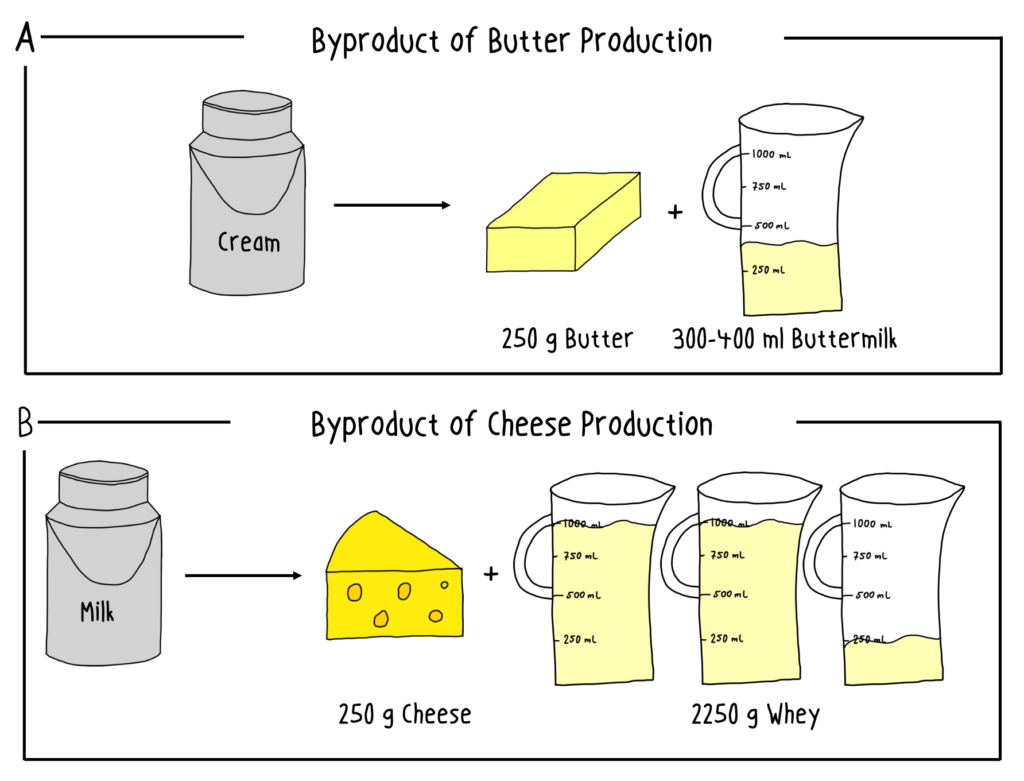
When the liquid separates from the solid part of milk, one might think the liquid consists only of water. However, since buttermilk and whey still contain many valuable components of milk, efforts are made to put them to good use. But how much whey and buttermilk are actually produced? The amount of buttermilk produced during butter production depends on the fat content of the cream used. If whipping cream with about 30% fat is used, the production of approximately 250 g of butter yields about 300 to 400 ml of buttermilk (Picture 5A). The amount of whey produced cannot be generalized either. It depends primarily on the type of cheese being made. However, the production of 250 g of hard cheese yields about 2.25 l of whey (Picture 5B). This example shows that whey, in particular, is produced in large quantities. That is why there are already many clever ideas for putting it to good use
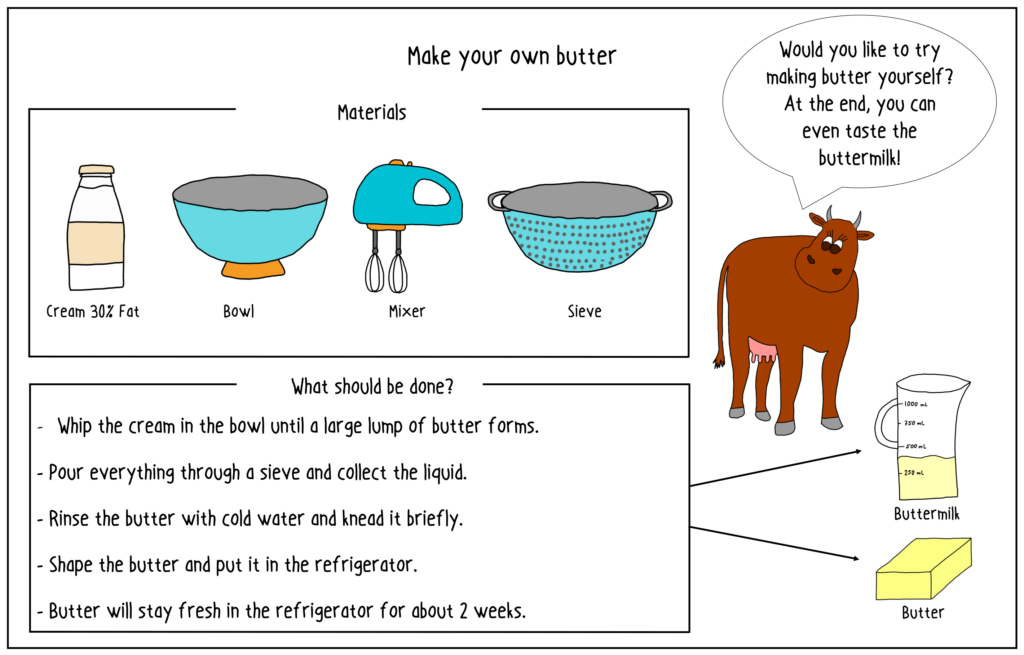
Experiment: Making Butter
How are these byproducts currently being reused?
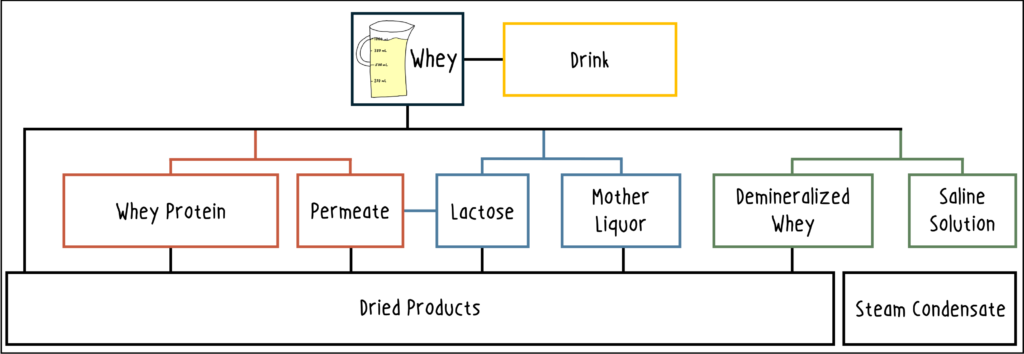
The simplest way to use whey and buttermilk is to sell them as beverages (Picture 6). To make their sour taste more appealing, they are often mixed with fruit. However, there is a particular problem with whey: the large quantities produced during cheese manufacturing cannot be consumed solely as a beverage. A popular method is therefore to process the whey into whey powder (Picture 6). Whey consists of about 94% water and around 6% solids, such as protein, lactose, and minerals. During the production of whey powder, the water is removed, leaving only the solid components. Whey powder has a major advantage: it has a much longer shelf life than fresh whey and requires less storage space. It can also be used as a substitute for milk in numerous foods. The powder can be mixed with varying amounts of water. This prevents too much liquid from diluting the product. But whey offers even more possibilities. Before it is dried, experts often first extract specific valuable substances from it. These substances can then be used specifically for certain products and often sold at a higher price. A particularly well-known example is whey protein (Picture 6). It is especially popular in the fitness industry. The liquid that remains after the whey proteins are removed is called permeate (Picture 6). But the permeate is also useful. Lactose can be extracted from it (Picture 6). This is used, for example, in food products or baby formula. After the lactose has been removed, a liquid remains. This is called mother liquor (Picture 6). Whey can also be used in another way. Some of its minerals can be removed. This whey is then called demineralized whey (Picture 6). It can be used, for example, as food for sick people. A saline solution is produced as a byproduct (Picture 6). However, there are few other uses for this salt solution. Many products created during whey processing are subsequently dried to extend their shelf life. This process produces various powders. Drying also produces something else: vapor condensate (Picture 6). This is water that forms during evaporation and later condenses back into a liquid. Milk residues are still present in this water. Therefore, it cannot simply be drained away. It must first be purified. But are the vapor condensate and the salt solution the only byproducts that remain?
What’s left over from whey?
Even though there are many ways to use whey today, there are still leftovers. This is because not all products are equally popular. By-products, in particular, are often in less demand than the main products. Whey proteins are especially popular in the fitness industry. Permeate, on the other hand, is used by only a few people. That’s why there’s often more permeate left over than is sold. Even when lactose is extracted from the permeate, the remaining whey is not fully utilized. Furthermore, not all dairies produce all products. Consequently, not all opportunities for further processing whey are always exploited. This demonstrates that while whey is a valuable raw material with versatile applications, components still remain unused. New uses must be found for these components in order to utilize as many substances as possible completely and in their most valuable form. But does it actually make sense to use all substances to the very end? This is precisely what the consideration of sustainability in economic production processes addresses.
How can whey be turned into a sustainable food product?
From 2025 to 2027, Infinite Roots and the Institute for Technical Biocatalysis will be conducting research on this—they’re using whey as a nutrient source for fungal mycelium and developing a new food product—available on Kniffelix.de starting in 2027!