

To understand why milk byproducts are valuable, you first need to know how much of a burden the dairy industry places on the environment.
What impact do milk production and dairies have on the environment?
Milk production consumes a lot of resources. Cows need feed, water, pasture, housing, and care. Growing feed crops like corn or soybeans takes up a lot of land, often in monocultures, which depletes the soil, reduces biodiversity, and requires more fertilizer and pesticides. Cows themselves produce greenhouse gases such as methane (CH4) and nitrous oxide (N2O). Dairy processing also consumes a great deal of energy: milk must be cooled, heated, separated, and pumped. Processes involving high temperatures, such as the preservation of milk, require a particularly large amount of energy. In addition, a significant amount of wastewater is generated, containing milk residues and traces of cleaning agents, which must be treated at great expense before it is released into the environment. The production of milk alone places a heavy burden on the environment—and its further processing into dairy products adds to this burden. This makes it all the more important that as much of the milk as possible is utilized.
How are milk byproducts processed today?
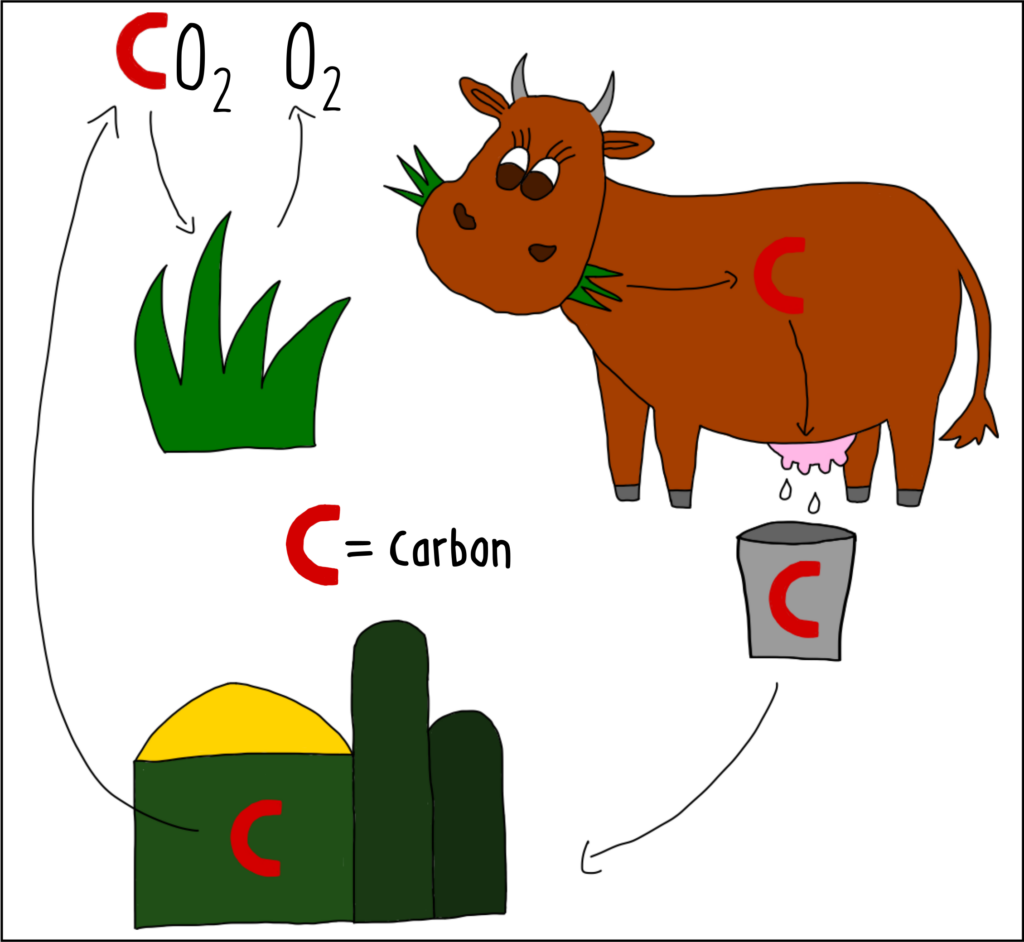
Milk byproducts are often used in biogas plants. There, microorganisms break down the materials and produce biogas, which consists mainly of methane (CH₄) and carbon dioxide (CO₂). The methane is burned to generate electricity and heat—either directly for the dairy or for the power grid. What makes biogas special is that the energy comes from substances that previously absorbed CO₂ from the air. In the case of milk, this happens through the cows’ feed. The CO₂ that the plants absorbed while growing is thus stored in the milk and the byproducts (Picture 7). When the methane is burned, this CO₂ is released back into the air. Unlike with coal or oil, biogas does not release old CO₂ that has been stored in the ground for centuries. Biogas is therefore more climate-friendly. Nevertheless, CO₂ enters the atmosphere, and too much of it harms the environment. Furthermore, the valuable nutrients in the milk residues are lost through decomposition. Proteins, sugars, and minerals consist of many different chemical building blocks and therefore have high material value. CO₂ and methane, on the other hand, are simple molecules—they provide energy, but they cannot be used to produce food or valuable materials. A truly sustainable approach would be not to break down these by-products, but to continue using them. Research and creative ideas can help turn today’s “waste” into tomorrow’s valuable raw materials. At the same time, the dairy industry can become more sustainable by making each stage of production more energy-efficient and environmentally friendly.
Do you want to guess where Germany’s energy comes from?
How can a dairy make its production processes more sustainable?
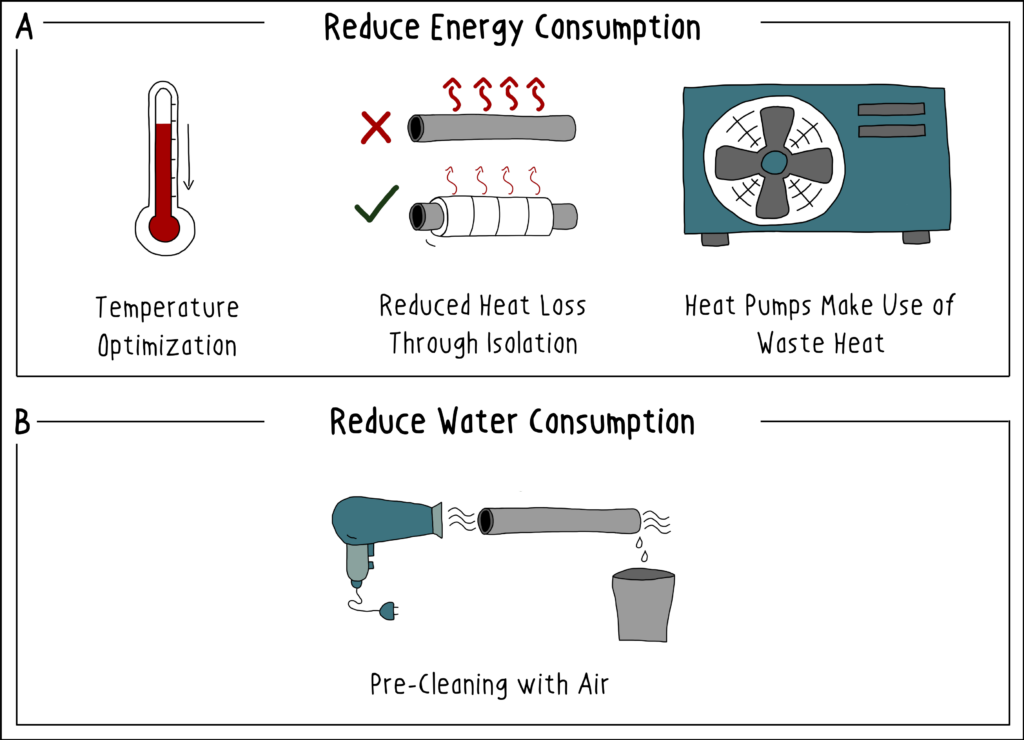
One key factor is reducing energy and water consumption. When it comes to energy consumption, it’s worth reviewing process temperatures. Many steps in cheese production have been carried out at specific temperatures for generations. Today we know that in many cases, slightly lower temperatures are sufficient—and this saves a lot of energy (Picture 8A). Since cooling also requires energy, these temperatures should also be reevaluated. Another important measure is to prevent heat loss. When heat is lost, it must be replenished, which requires additional energy. Well-insulated pipes, boilers, and machines help reduce such losses (Picture 8A). Additionally, waste heat can be utilized. Waste heat is heat generated, for example, during the operation of machines. Since this waste heat is often not hot enough for many industrial processes, heat pumps can raise it to a higher temperature and thereby make it usable (Picture 8A). If heat pumps are powered by electricity from renewable sources, this is particularly environmentally friendly. A great deal of energy can be saved when heating and cooling are considered together. In a dairy, for example, cold milk is first heated, and after cheese production, the warm whey is cooled again. Energy is required for both processes. However, a so-called heat exchanger can be used to combine the two processes: Here, the whey transfers its heat to the milk and cools itself in the process, thereby saving both heating and cooling energy. There are also opportunities to save water, for example through water treatment and reuse or through more efficient cleaning processes. If the excess milk in the pipes is first removed with a strong airstream, less milk remains in the pipes, and less water is needed for cleaning (Picture 8B). However, implementing such changes is often complex. Dairies have grown over many years, and the individual steps are closely interlinked. Even small changes can have a major impact on the overall process and costs, as well as cause complications. This can quickly disrupt the production flow.
Sustainable change requires long-term planning and can only be achieved through a combination of measures that address manufacturing processes as well as the use of water and heat. The goal is to utilize raw materials as fully as possible and transform them into valuable products, thereby preventing waste or low-quality byproducts and conserving the environment and resources.
How is whey turned into a sustainable food product?
This is exactly what Infinite Roots and the Institute for Technical Biocatalysis will be researching from 2025 to 2027—they are using whey as a nutrient for fungal mycelium, which is then processed into a new food product. Starting in 2027, you can explore this exciting topic on Kniffelix.de.