

You can see especially beautiful, shimmering colors in nature on beetles and butterflies. Have you noticed that a butterfly keeps its shimmering colors even after many years? These colors have a different origin from the colors of our T‑shirts, which fade over time. Do you have an idea why? Tell us in the comments!
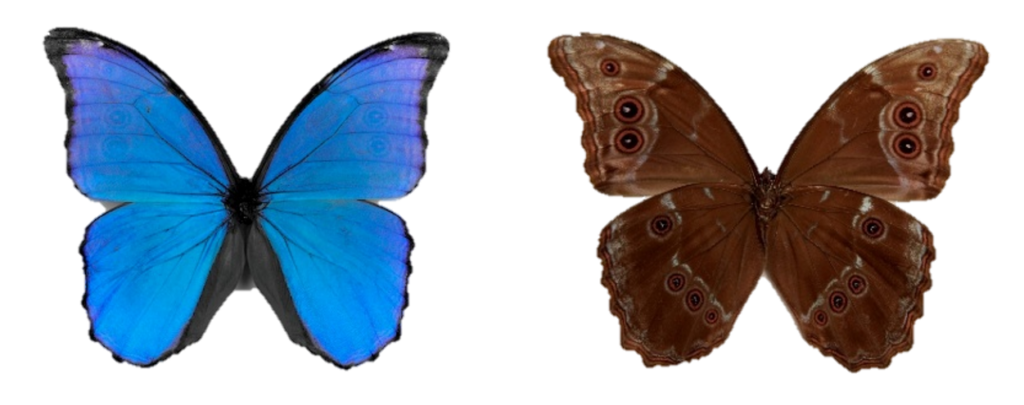
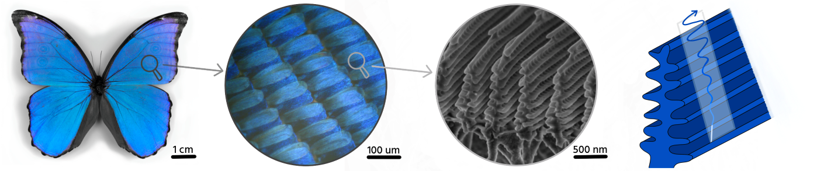
To uncover the butterfly’s secret, we looked at its wing under a microscope. At low magnification you can see many tiny scales with fine ridges. At higher magnification, you can see even smaller, branch‑like structures that look like little trees. These structures are so small that they can interact with light waves. Each tiny “branch” acts like a small mirror that reflects the incoming light. If a particular color wave of light is reflected so that the wave crests line up exactly, that color is strengthened and comes back very bright. This is called constructive interference (see also Chapter 1:Basics: What is Light?). The distance between the branches decides which colors are reinforced. In our butterfly, the spacing fits blue light, so the blue waves add up and the butterfly looks shimmering blue. On the underside of the wings there are no tree‑like structures, so no blue light is reflected. By folding its wings, the butterfly can blend in and hide from predators
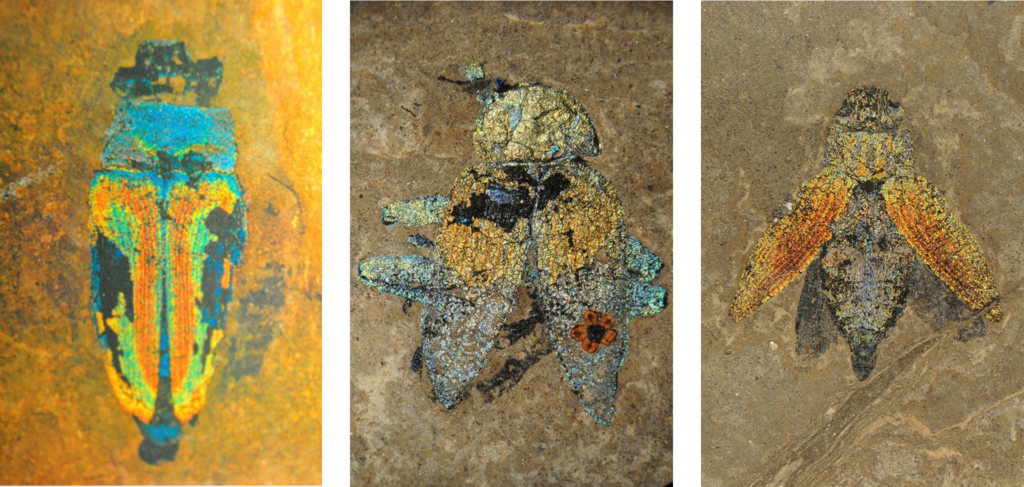
The butterfly’s wings do not contain colorant. Instead, the color comes purely from how light waves interact with the tiny structures of the wings. These colors are called structural colors. Their advantage is that they do not fade as long as the structure stays intact. This even lets scientists work out the original colors of ancient animals from fossils.
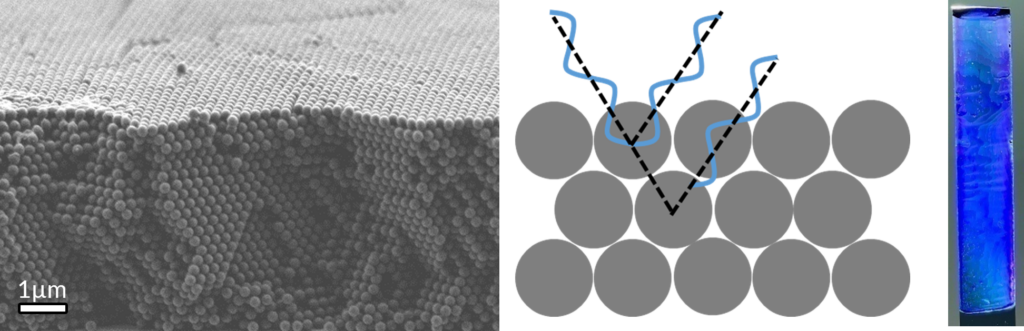
At the Institute of Interfaces and Particle Technology of the FAU Erlangen-Nürnberg we try to recreate these shimmering natural colors in the laboratory. We use tiny silica particles (silica is what glass is made of). They are so small – only a few hundred nanometres – that they can interact with light waves. In the lab, we arrange the particles in very ordered layers. You can see how we make these layers in our video. Note: To watch the video with subtitles, follow the link.
When light waves hit the layers of particles, they “see” structures similar to the tiny “trees” on a butterfly’s wing. The incoming light is reflected by each particle layer, just like at each little branch on the wing. The reflected color waves strengthen each other when the spacing between the layers matches the wavelength of the light – so the wave crests line up. This is called constructive interference, and it makes the color much stronger.
By changing the size of the particles, we can tune which color is reflected. In our example, the particles are just the right size so that the blue waves interfere, giving the same shimmering blue seen in the blue morpho butterfly (see figure above).

Extra info: Structural colors aren’t just useful as pigments; they can also act as sensors. If the environment around the particle layers changes – for example, if a liquid fills the gaps between the particles – the observed color changes. This color change can be used as a warning signal for dangerous substances.
Thin Film Experiment

We’ve learned that structural color is based on interference. Let’s use this idea to make structural color at home. You will need: a bowl of water, a few drops of oil, and a torch.

Result: Put a few drops of oil on the surface of the water. The oil spreads out to form a thin film. Shine the torch onto the oil film. You will see the “oil puddle” shimmer with many colors. Why does this happen? Light is reflected at the boundary between air and oil, and again at the boundary between oil and water. Some color waves fit the film thickness just right, so wave crests of the reflected waves line up and the light is strengthened. Because the color depends on the film’s thickness, different parts of the film show different rainbow colors.
Alternatively: The same effect happens in soap bubbles. That’s why soap bubbles shimmer with all the colors in sunlight. In our video, we explain you how this works. Note: If you want to watch the video with subtitles, click on the video link.
Application
Pigments that get their color from their structure are found not only in nature; they are also made industrially.
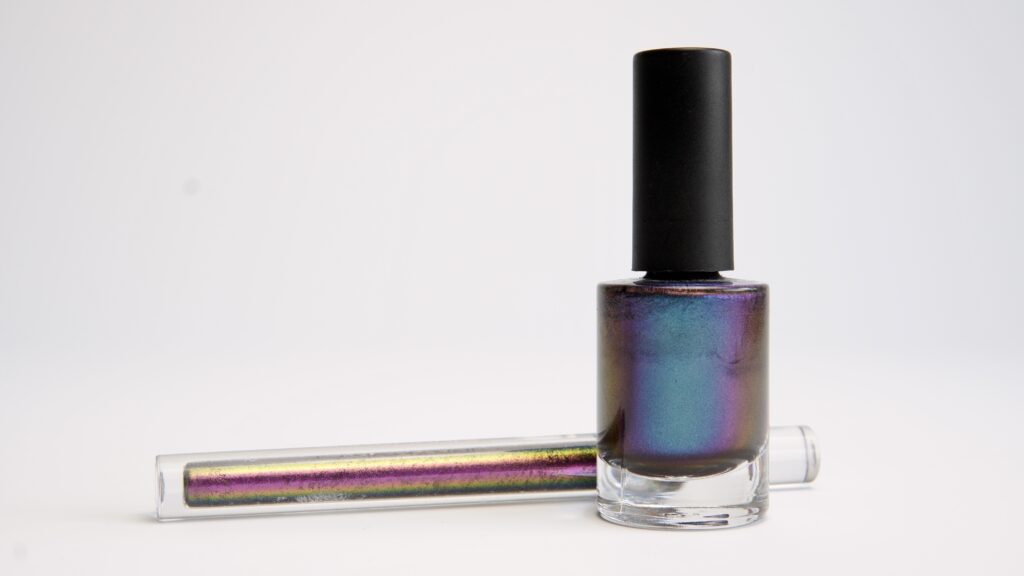
For example, interference pigments are used in cosmetics and car paints. These pigments have very thin layers that reflect light waves, similar to the particle layers we made in the lab. This creates color effects like the ones we see on a butterfly wing.
Photo Copyright © G. Magnabosco