
Although cow’s milk originally is meant to feed calves, many human cultures consume it lifelong, processing it into various food.
What is cow’s milk made of?
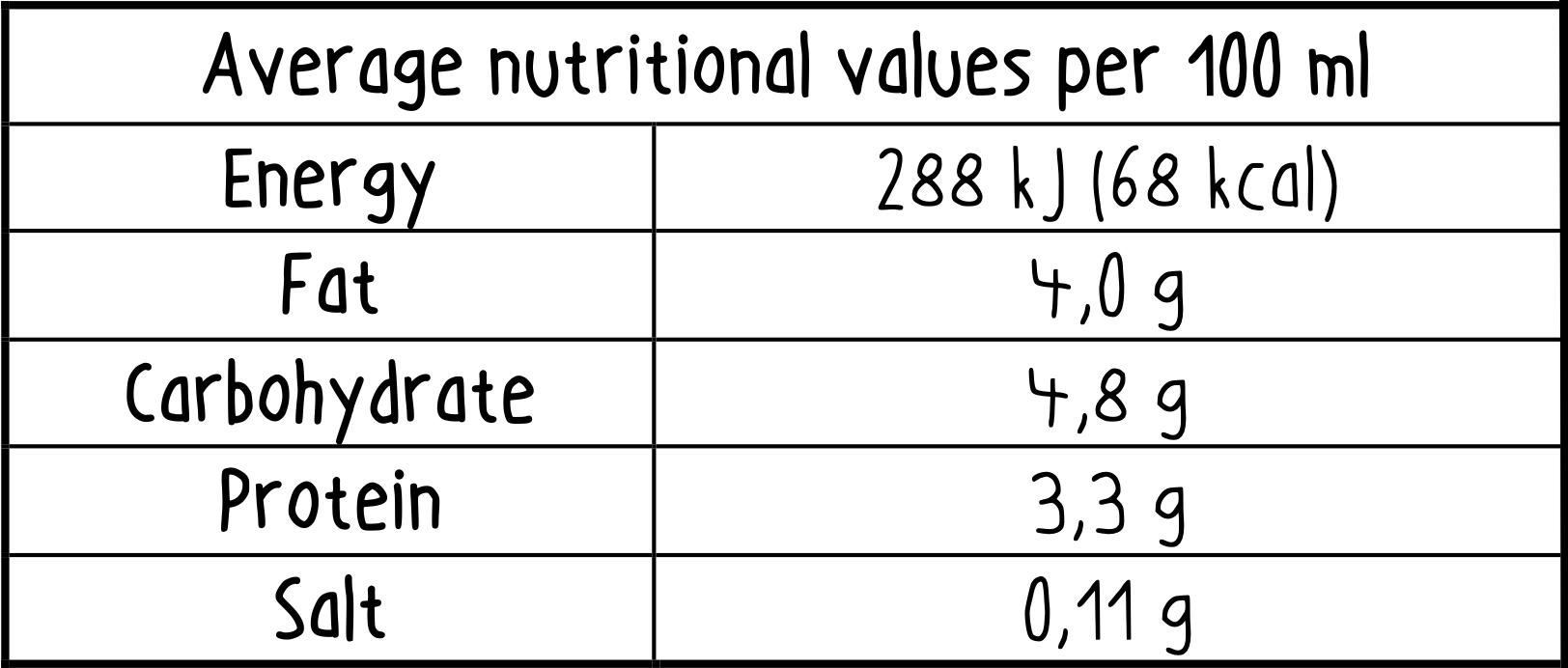
Indeed, Milk consists of 80% water, but the remaining 20% contain numerous essential nutrients for the human body. Those who want to know which nutrients are found in particular foods should look up the nutritional table on the package. For most processed foods, the inclusion of a nutrient table is required by the EU. It shows the energy provided by particular foods and the nutrients it contains. These nutrients are energy (calories), fat, carbohydrates, albumen (protein), and salt. Generally, declarations are made per 100 ml or 100 g. 100 ml of whole milk contains approximately 68 calories, 4 g of fat, 4.8 g of carbohydrates, 3.3 g of protein, and 0.11 g of salt (Table 1). Alongside these contents, milk has a lot of minerals and vitamins. Since our body is unable to produce some of these substances, we need to take them in through food. At first glance, these terms simply describe groups of nutrients — but what specific substances does milk actually contain? Carbohydrates in milk almost entirely consist of lactose, a sugar, the so-called milk sugar. Lactose is composed of two sugars, glucose and galactose, which are connected. Proteins play an important part in milk as well. The major part of proteins in milk is casein. This is particularly important for the manufacturing of cheese. Roundabout 80% of milk protein is casein, the remaining 20% are whey-protein. Another vital ingredient is fat. Milkfat is to be found in very small fat pellets. Altogether, milkfat contains more than 400 different fatty acids. Drinking milk is available with varying fat rates – from skimmed milk with 0,5 % fat up to whole milk with more than 3,5 % fat. But: how do all the different fat rates develop?
Fancy a little game? What simple sugars does lactose consist of? Can you drag the simple sugars to the correct place?
Tip: Pay attention to the order of the simple sugars.
How do different fat contents develop in drinking milk?
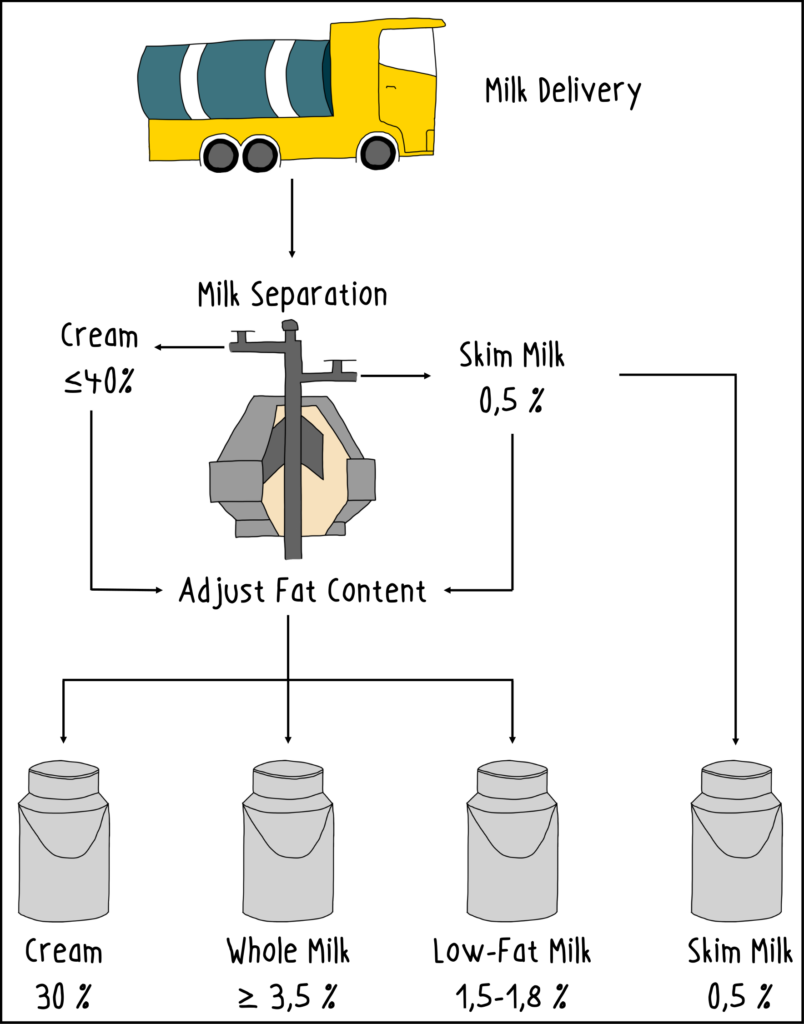
Milk that comes directly from the cow (raw milk) has a naturally varying fat content. In the supermarket, however, milk must always have a certain fat content. What to do? The milk is divided into a fat-reduced and a high-fat part (picture 1). Normally, the fat would rise to the surface on its own if you let the milk sit for a while. To accelerate the process, a fast-rotating machine (centrifuge) is used, which separates milk effectively into skimmed milk, containing almost no fat, and high-fat cream. After this, skimmed milk and cream are mixed again, to produce milk with different fat contents; for instance, whole milk, fat-reduced milk or cream. Without further processing, the fat would eventually rise to the surface again. But why doesn’t that happen with milk from the supermarket?
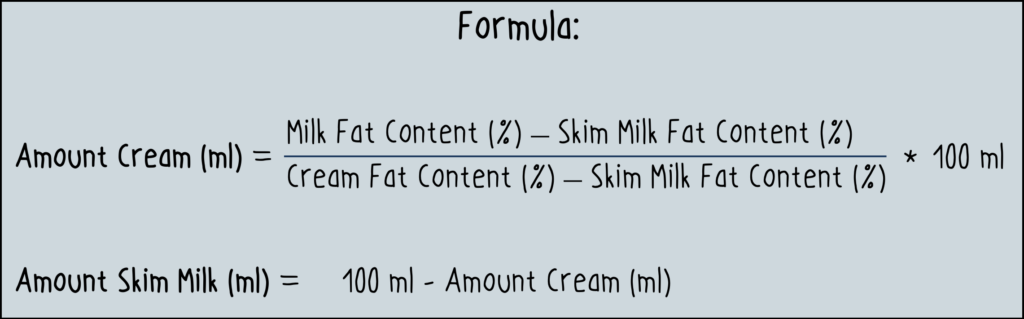
Do you want to adjust the fat content of milk yourself? You will need the following formulas:
How is fat separation on the surface of the milk prevented?
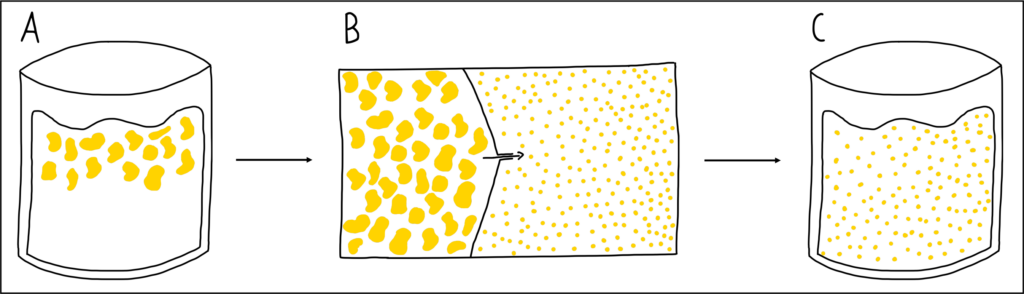
Among other things, milk consists of fat and water. Originally, the said substances don’t mingle quite well. To avoid fat settling on the surface, milk is homogenized. The fat globules are forced through a small opening, which significantly reduces their size (picture 2). This ensures they are evenly distributed in the milk. You get a solid compound called an emulsion. By homogenizing, fat stays evenly distributed, and milk will become more creamy. Milk is used for different products, such as yoghurt, cooking cream, or condensed milk. The milk used for cheese or butter is not going to be homogenized; for these products, you need the fat pellets to embed together. Apart from homogenizing, it is important for a dairy plant to make milk last longer.
How is milk preserved?
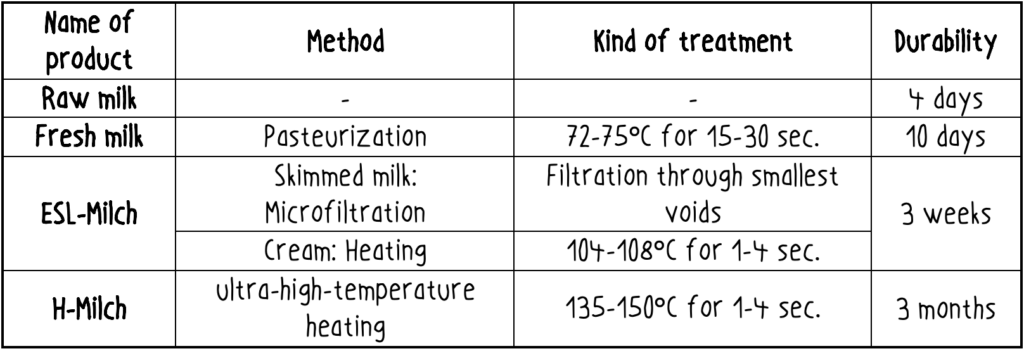
Raw milk can be kept for up to four days. To make it keepable, contained germs have to be reduced or killed (Table 2). One of the oldest methods is pasteurization. Hereby, milk is shortly heated. This process kills many germs while preserving most of the nutrients. Yet some heat-resistant germs may survive. Therefore, pasteurized milk has to be kept in the refrigerator, where it can be kept for up to ten days. In supermarkets, this kind of milk is called „fresh” milk. Alternatively, a procedure named microfiltration is used. Skimmed milk is led through a high-efficiency filter to extract bacteria. After this, it is mingled with heated cream to reach the requested fat content. Milk treated in this way is called ESL-milk (Extended Shelf Life) and is labeled as “longer-lasting” milk in supermarkets. It will stay fresh for up to 3 weeks if refrigerated. Milk can be made to last even longer using ultra-high-temperature (UHT) processing. In this process, the milk is heated to 135–150 °C for a few seconds. This allows it to be stored unrefrigerated for up to three months. It can now be labelled as H-milk. (the h for haltbar = durable).