
Pore Structure
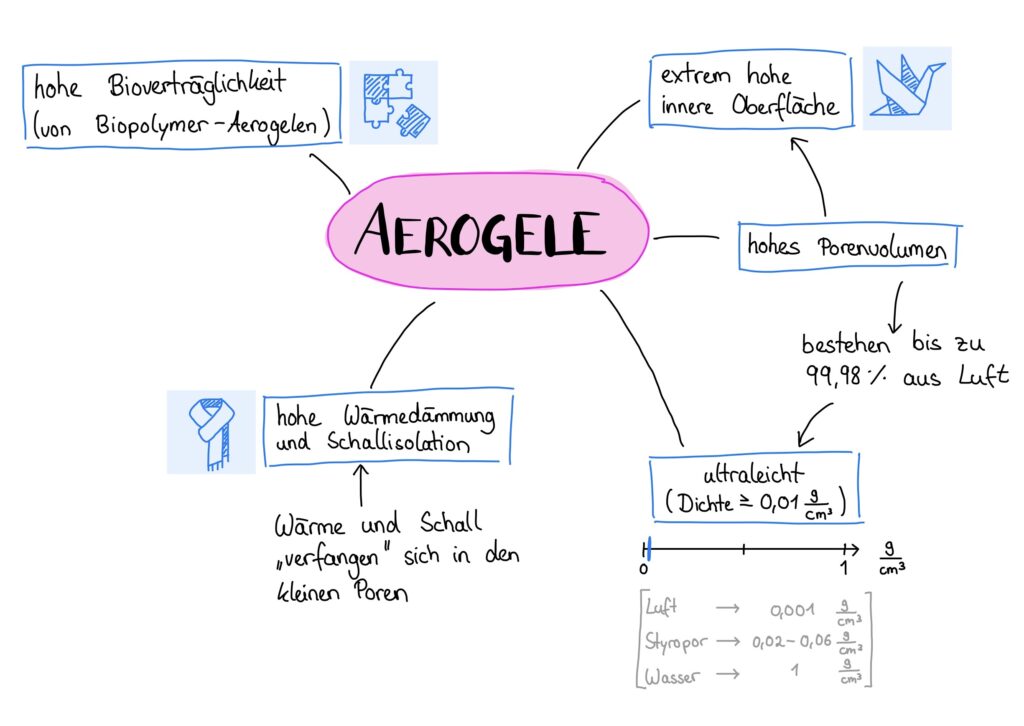
The special thing about all aerogels is their structure: like sponges, they contain a very large number of pores. In aerogels, however, these are so small that they are no longer visible to the naked eye but only with high-resolution microscopes (e.g., scanning electron microscopes). Due to this particularly fine pore structure, aerogels not only have an outer surface but, above all, a huge inner surface. If you could unfold a few grams of an aerogel and spread out the surface of all the pores, it would be about as large as a football field!
Because their pores are filled with air, aerogels also have a very low density of up to 0.01 grams per cubic centimeter and are therefore ultra-light. If you want to know more about pores and solve a task related to them, feel free to check out the “Excursion: Interesting Facts About Pores“.
Thermal Insulation
A particularly important property of aerogels is their extremely low thermal conductivity. At only approx. 0.019 W/(m*K), this is even lower than that of air! In the illustration, you can see the thermal conductivities of various materials in comparison. The lower the thermal conductivity, the thinner the insulating layer can be: To achieve an insulating effect of 0.25 W(m^2*K), for example, you could use either an 80 cm thick layer of wood or a mere 8 cm thick layer of aerogel!
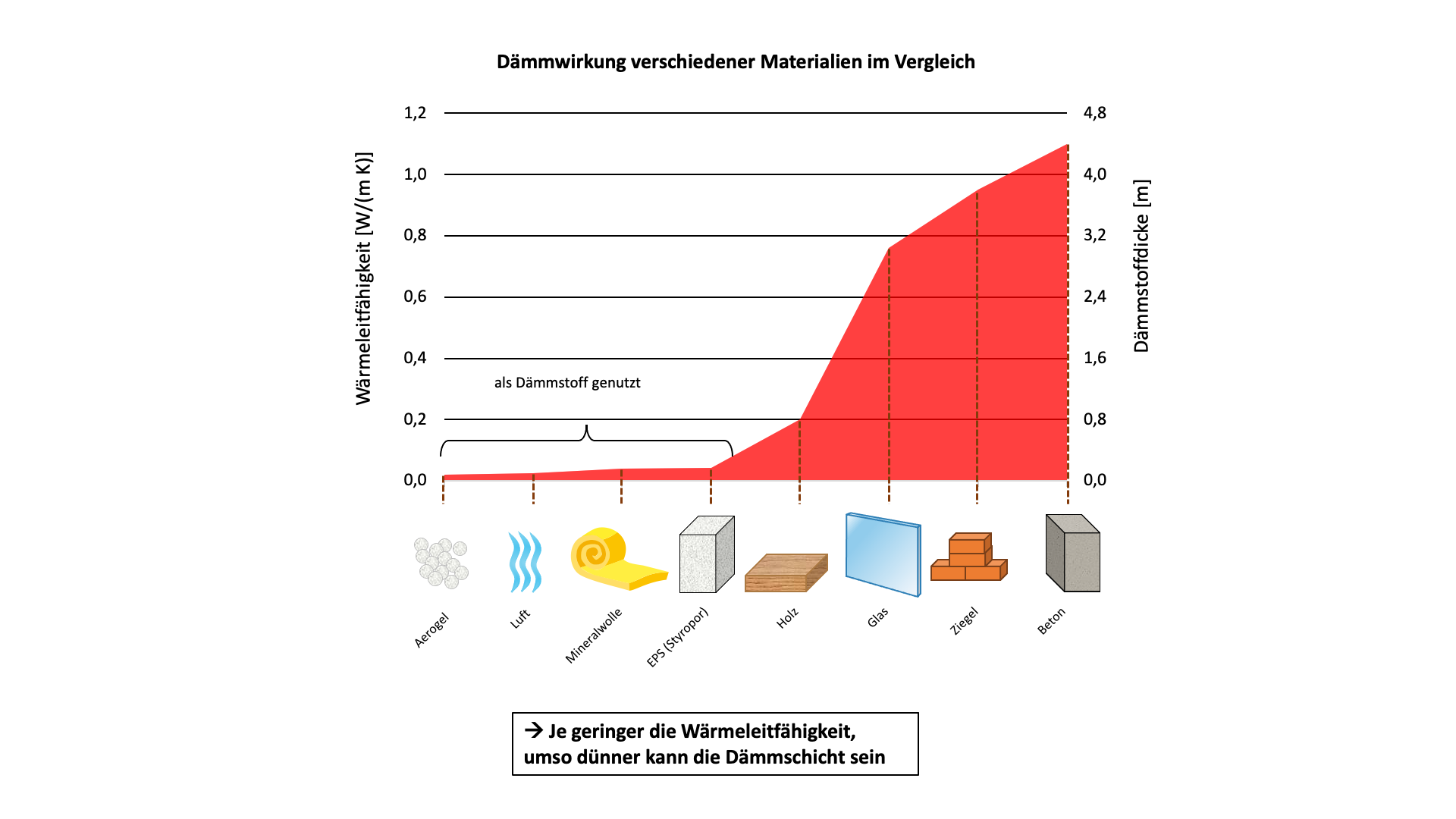
But why is that? Simply put, heat gets trapped in the pores of an aerogel like in a labyrinth and can therefore only be transferred with great difficulty. Because aerogels have a particularly fine pore structure, their insulating effect is higher compared to other materials. Therefore, they are very well suited as insulating materials. In fact, most other insulating materials like Styrofoam and mineral wool are also porous, but because their pores are larger, their thermal conductivity is higher. You will learn exactly how heat transport works in insulating materials in the following puzzle!
Technical Use
Various technical applications are derived from the properties of aerogels. However, what an aerogel can be used for also depends on the starting materials. For more on this, take a closer look at the article Applications of Aerogels! You can already deduce some of the applications yourself; to do so, solve the following puzzle: