
But why aren’t aerogels used everywhere already?
In the near future, there is great potential for new applications of aerogels. Nevertheless, they are currently hardly used technically. On the one hand, this is because aerogels are a relatively new research topic. On the other hand, it is mainly due to the complex production and thus the high price of aerogels: For a long time, aerogels could only be produced in small quantities in the laboratory. However, with the EU research project NanoHybrids, it was possible to further develop the production process so that larger quantities of these novel materials could be produced for the first time. This research project was carried out from 2015 to 2019 by twelve research institutes and industrial partners from seven countries under the leadership of the Technical University of Hamburg, Institute of Thermal Process Engineering, Prof. Irina Smirnova.
Opportunities for the future
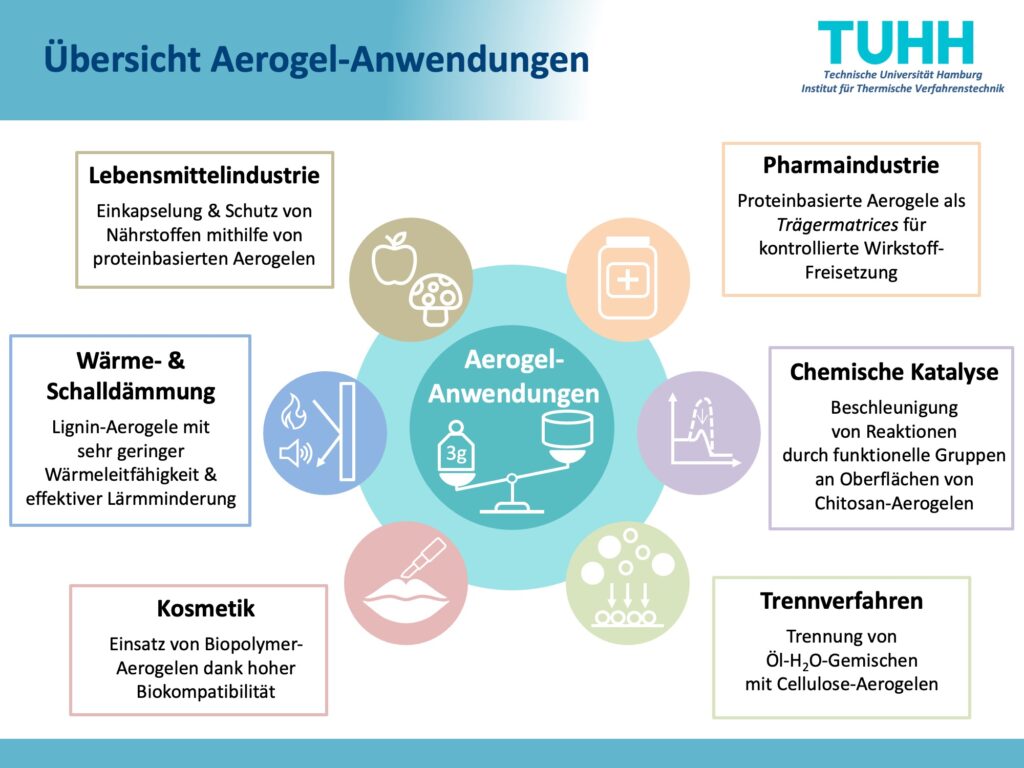
Now that more of these materials are available and production costs are falling, the use of biopolymer aerogels can be considered in many areas. Since a wide variety of materials can be used as starting materials for aerogels, including proteins and starch, edible aerogels can be produced. This could be used, for example, to incorporate drugs into aerogels, which are gradually released in the body after ingestion. Likewise, aerogels could be used as carriers of flavorings and vitamins for dietary supplements or active ingredients in cosmetics. In agriculture, aerogels could release pesticides in a controlled manner, thus leading to more economical use of these agents.
Last but not least:
From Kniffelix to new research
– what this science communication project triggered
Normally, it’s the other way around: First, we researchers develop a special product and then report on how we got there – for example, here on the Kniffelix website. When we wanted to explain aerogel production in an understandable way as part of our collaboration between the Institute of Thermal Process Engineering and the Kniffelix team, that’s exactly what we intended. However, the idea of how we could explain aerogels and supercritical drying to you then developed into an independent scientific project involving numerous researchers at TUHH and international experts. But how did that happen?
After the idea of explaining gel drying using fruit and vegetables as an example (see Mission 2c), we wondered if we couldn’t also consider apples, orange peels, mushrooms – and generally all living tissues – as naturally grown, porous hydrogels and convert them directly into aerogels. To pursue this idea, we were able to inspire numerous researchers and students who converted 20 different food scraps into aerogels in the lab through the following steps: Grinding in a kitchen mixer, washing with water, solvent exchange with ethanol, and supercritical drying. You can see the production below (b), and it is significantly simpler than the “normal” aerogel production (a).
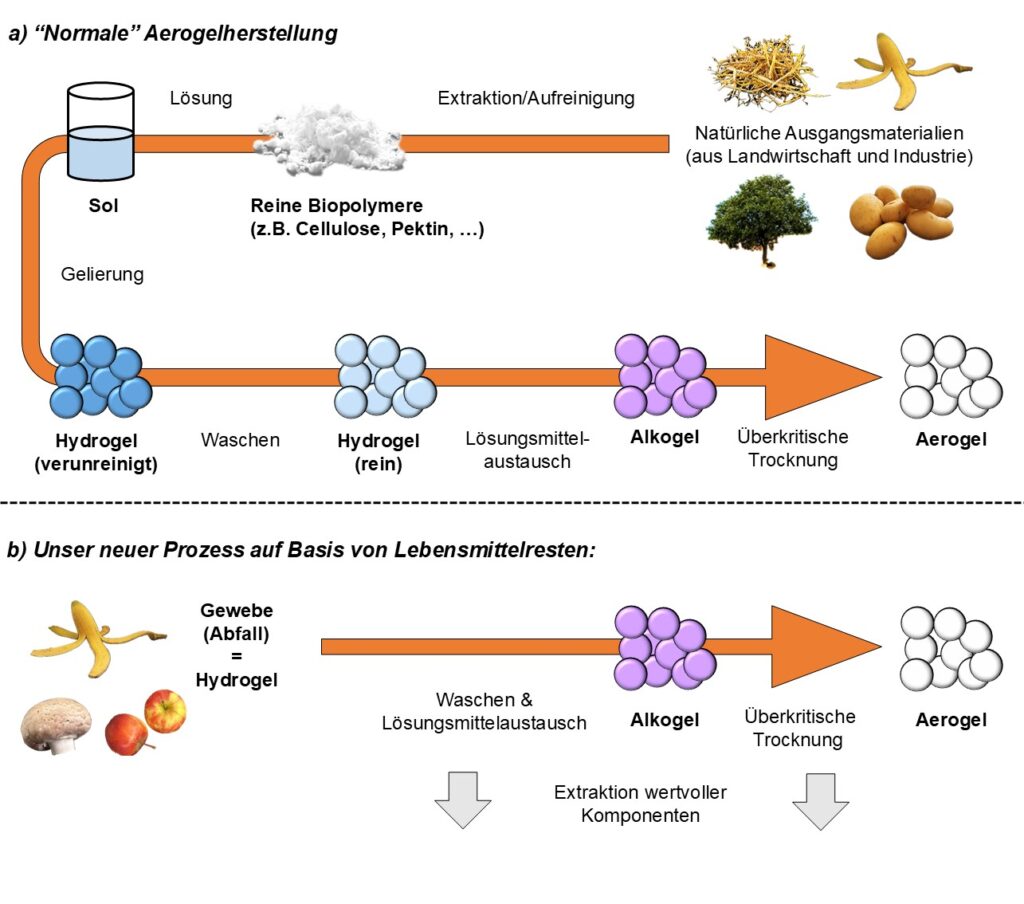
Here we were able to show that all tested tissues exhibited aerogel-typical properties, in particular, they consisted almost entirely of air (high porosity) and showed high specific surface areas of up to approx. 450 m2/g. Although it sounds simple (and is!), this has not been reported before – probably because many food scraps are normally dried in the air before further processing (and then pores are lost).
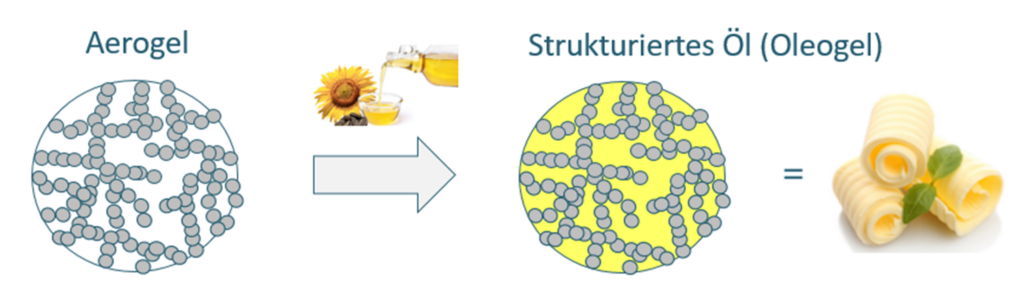
The produced fruit peel and vegetable aerogels have high application potential, e.g., in the food industry. Here they can be used to make liquid oils as spreadable as butter or margarine by binding the oil in their pores. These so-called “oleogels” are of interest because liquid oils such as sunflower oil are much healthier for humans than solid fats.
In summary, our idea not only led us to discover a simplified aerogel process but also to convert food waste or by-products – instead of throwing them away or using them as pig feed – into high-performance aerogels. And there are certainly more application possibilities than shown in our study. Curious? Here is the (English) scientific article:
https://pubs.rsc.org/en/content/articlepdf/2025/GC/D4GC05703A

Assignment:
Aerogels are used as insulation materials. Assign the different materials to their thermal conductivities. (This puzzle without aerogel is from the website LEIFIphysik.)