
Aerogels can be produced, for example, from sodium alginate, a plant-based gelling agent from brown algae. For this, you need sodium alginate and calcium chloride. With simple household equipment, you can produce a hydrogel from these. For your own experiment, see the experiment instructions. The gelation of the alginate can also be seen in the video here: https://www3.tuhh.de/kniffelix/en/2e-gelation/
First, the alginate and calcium chloride are dissolved in water in separate containers. Then, the alginate solution is dropped into the calcium chloride solution using a syringe or pipette. This forms solid gel beads.
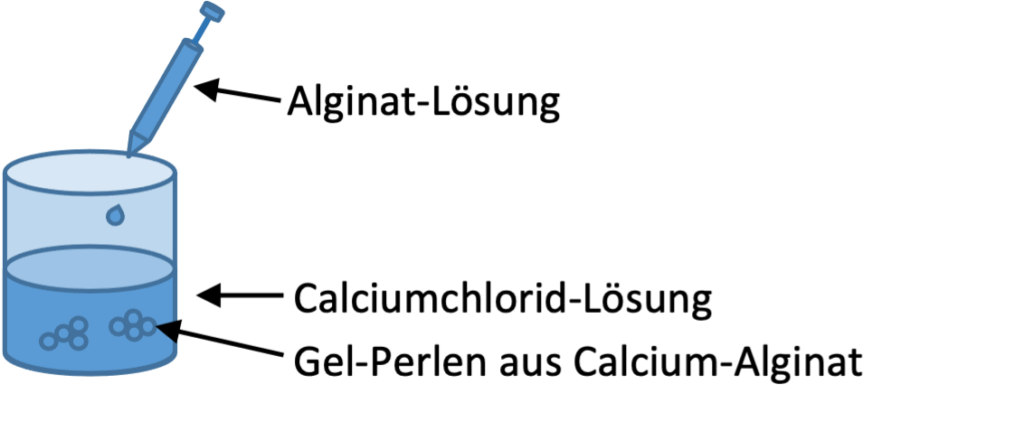
What happens here is referred to as the “egg carton mechanism”.
What is the “egg carton mechanism”?
The “egg carton mechanism” is spoken of when alginate chains encounter calcium ions. The alginate chains arrange themselves in such a way that they enclose the calcium like an egg in an egg carton – hence the name “egg carton mechanism”.
This enclosing happens because chemical groups with different charges attract and link each other. From everyday life, you probably know this from magnets, where the different poles, North Pole and South Pole, attract each other. The calcium ions behave the same way with the alginate chains, more precisely with the oxygen atoms in the alginate chains: Some oxygen atoms carry a negative electrical charge, while the calcium ions are positively charged. That’s why they attract each other and connect.
If you write this down in chemical formula language, it looks like this:
Ca2+ = doubly positively charged calcium ions
COO– = negatively charged oxygen-containing groups on alginate chains
Each calcium ion can link two alginate chains together, as it connects with two singly negatively charged COO– groups.
In the diagram, you can see what it looks like in chemical formula language when alginate chains and calcium ions link together.
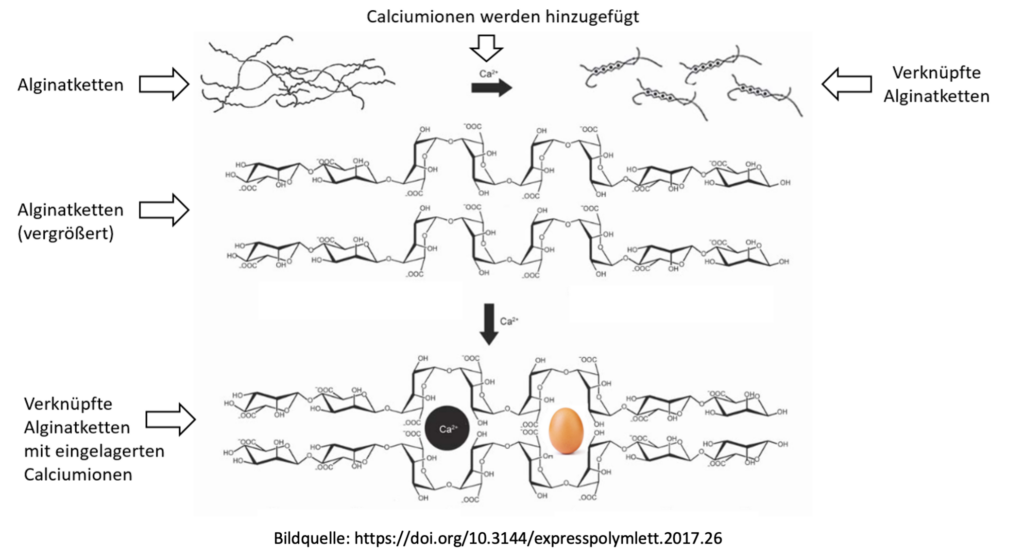
When gel formation occurs, you have to imagine that this reaction occurs very frequently in each alginate chain. This creates a linked alginate chain network with pores, the “alginate hydrogel”.
You can also make an artificial egg with alginate. Watch this fun video: