
As you probably know, there are three different states of matter: solid, liquid, and gaseous. For example, water is called ice, water, or steam depending on its state of matter.
What is often not mentioned in school is that there is also a supercritical state. But how can we imagine that at all?
| solid | liquid | gaseous | supercritical |
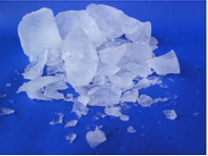 | 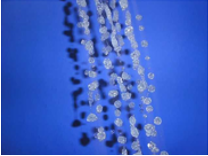 | 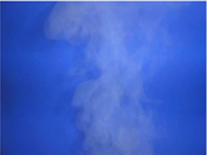 |  |
Source: https://de.serlo.org/chemie/25371/aggregatzustand, License CC-BY-SA 4.0
To do this, let’s first go into a little more detail: The state of matter a substance is in depends on temperature and pressure, which is why substances can change their state of matter when temperature or pressure changes. Simple examples are the freezing of water in the freezer or the evaporation in a cooking pot: in each case, the temperature is changed to bring about the change of state. However, pressure also has an influence: perhaps you know that the fact that water boils at 100 °C only applies at normal pressure. In a pressure cooker, you can increase the pressure so that water only begins to boil at a higher temperature, e.g., 120 °C. The higher temperature means that food does not need as long to soften, which saves time and energy. If, on the other hand, you want to cook on a high mountain where the atmospheric pressure is lower, the water will boil at lower temperatures, but the food will take longer to cook.
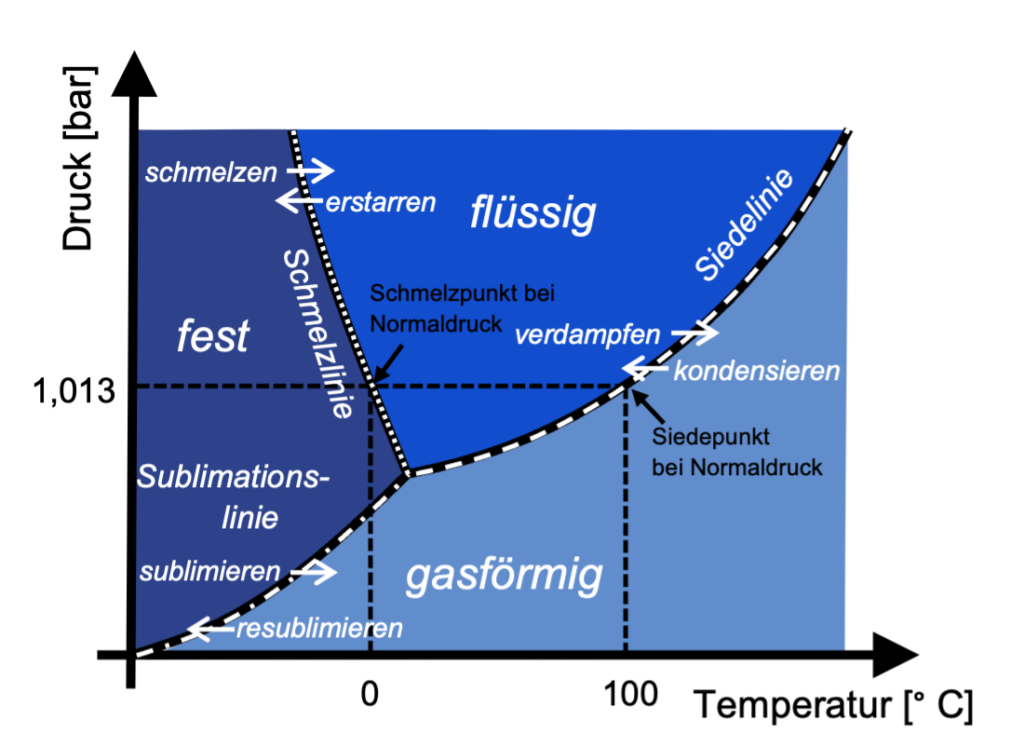
Since the state of matter depends on temperature and pressure, the transition between two states of matter is also dependent on temperature and pressure. Therefore, there is not just one boiling temperature or a boiling point, but a boiling line, which shows the boiling temperature as a function of pressure.
The Phase Diagram
In a phase diagram (see Figure 2), the states of matter can be represented as a function of pressure and temperature with lines representing the transitions between the phases.
The Influence of Temperature and Pressure Explained in the Particle Model

The states of matter can be visualized in the particle model: In the solid state, the particles are close together and can hardly move. They are usually depicted as monochrome spheres, but since attractive forces between the particles also play a role, they are shown here like magnets in red-green (different colors attract, same colors repel). When a solid is heated, the particles move a little more, so the solid expands. At the same time, the attractive forces become weaker due to the increased distance. (Exception: water between 0 and 4 °C expands when cooled, see density anomaly of water)
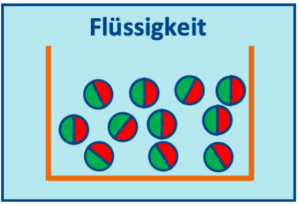
When the melting point is reached during heating, more and more particles detach from the close solid arrangement and transition into the liquid state. There, they are no longer fixed in place but can slide past each other. This means liquids do not have a fixed shape but still have a defined volume. If the liquid is heated further, the same applies as in the solid phase: more energy is added to the particles, causing them to move more. The distance increases, and the liquid expands.
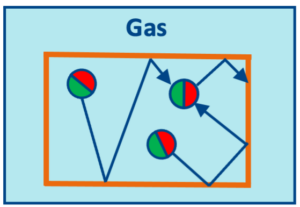
With further heating, a threshold is eventually reached here as well: the boiling point. At this point, more and more particles detach from the attractive forces that still act in the liquid phase and move freely in space as individual particles. Thus, they are in the gaseous state, where they have the greatest distance and move very quickly. (A random collision of such particles due to their high speed is more likely to result in them bouncing off each other than the attractive forces coming into play again.)
So far, the influence of temperature on the state of matter has been described.
But what influence does pressure have? If you increase the pressure, you confine the same amount of particles into a smaller volume. They then come closer together again. This is particularly easy when the particles are in the gas phase. They can then be easily compressed. In the liquid and especially the solid phase, high pressures must be applied to compress the particles even more.
If you imagine that the particles in a liquid move more the hotter it is, and at the same time, that a gas contains more particles the higher the pressure, you can perhaps imagine that when high temperatures and high pressures occur simultaneously, the difference between the gas and liquid phases disappears. At this point, the supercritical state is reached.
IMPORTANT: In the supercritical state, there is no difference between the gas and liquid phases. It is reached at high temperatures and pressures. How high these are exactly depends on the substance.
Can the supercritical state be seen?
Yes! You will learn exactly what it looks like and how it can be described using the phase diagram of a substance in the following video:
Researchers can observe in experiments when the critical point is reached: they use a viewing cell, a pressure-resistant, heatable container with a window, and fill it with, for example, water and bring it to a boil. At the boiling point, they see a liquid and a gaseous phase separated by a phase boundary.
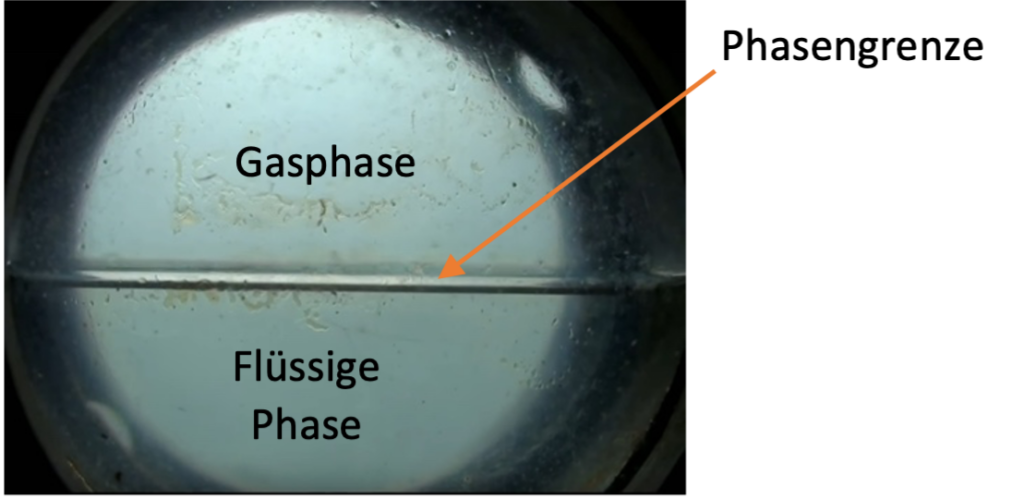
If you now increase the pressure and temperature simultaneously in such a way that you stay on the boiling line, you will eventually reach the critical point, beyond which the difference between the gas and liquid phases disappears. At this point, you will no longer see a phase interface. The disappearance of this line is therefore the only thing you can see.
In the phase diagram, the critical point is the upper end of the boiling line. Above it begins the supercritical state. Let’s compare the supercritical state of water and carbon dioxide:
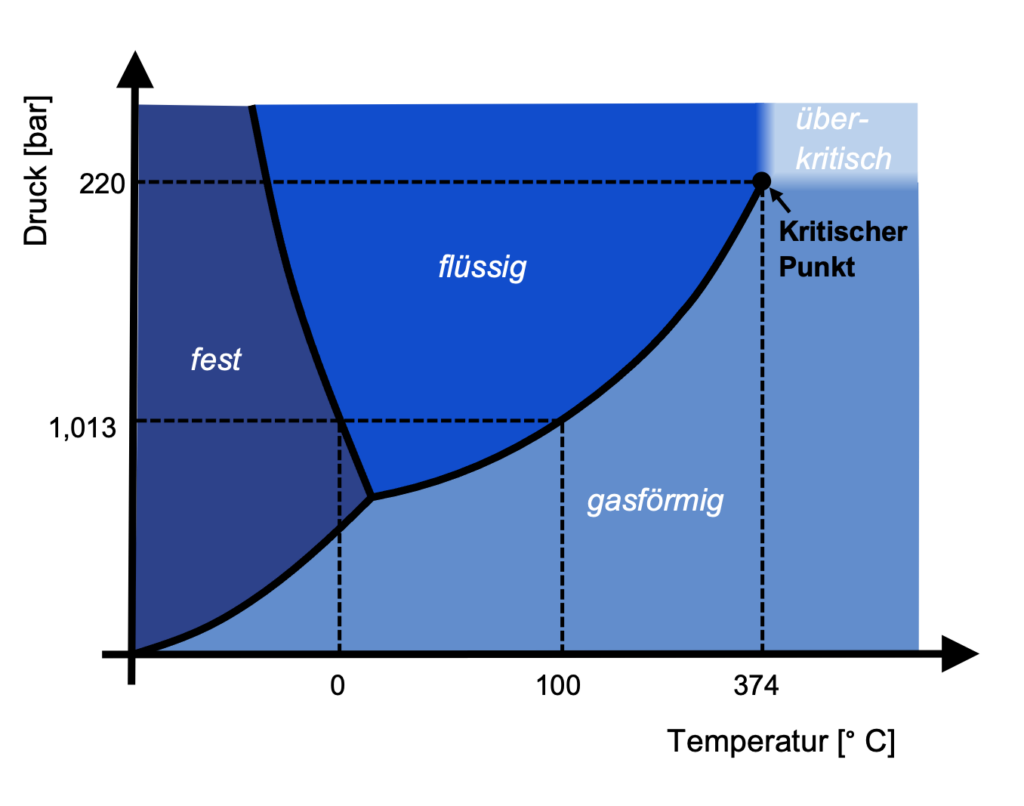
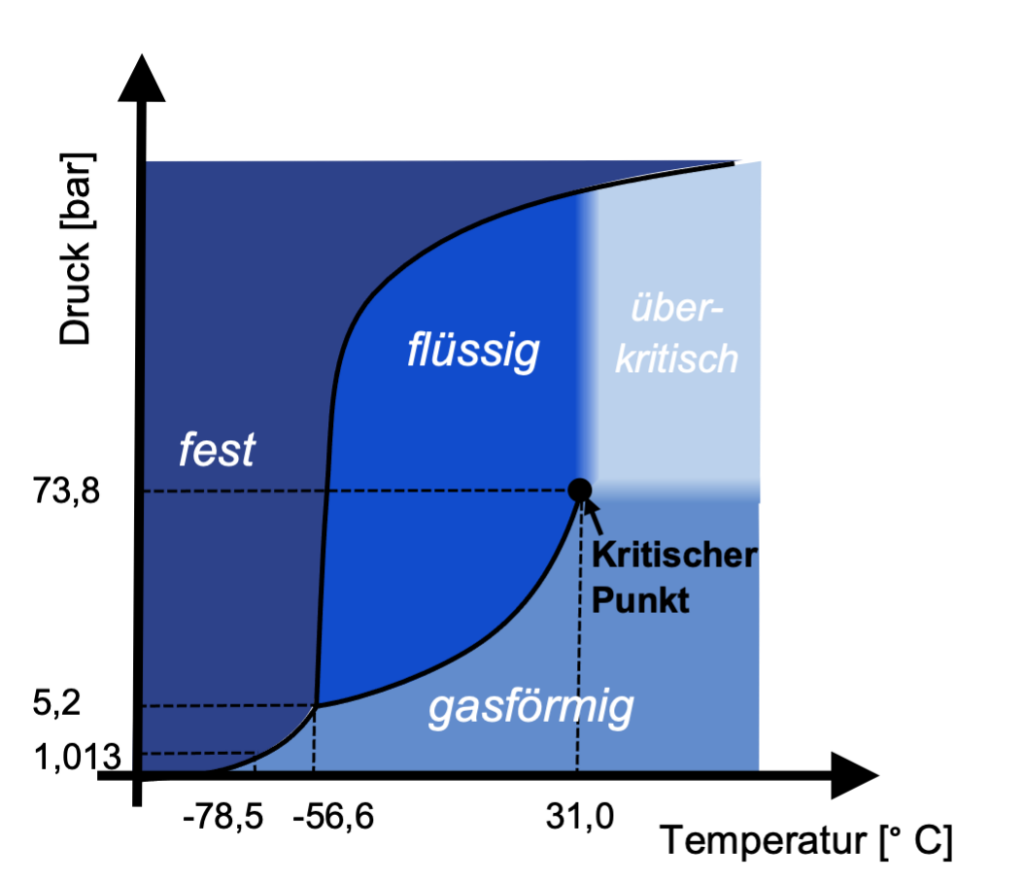
To reach the supercritical state of water, a very high pressure of 220 bar and a high temperature of 374 °C are required. For many other substances, the values are lower, e.g., for carbon dioxide, only 73.8 bar and 31 °C are needed.