
When gels are dried in the air, the liquid within them evaporates, and the gel shrinks. We also know this phenomenon from fruit. The reason for this is that during evaporation, capillary forces pull the gels together so strongly that the structure breaks. Therefore, aerogels cannot be produced by air drying, nor by drying in a conventional oven, because the same thing happens.
What are capillary forces?
Capillaries are fine, long hollow spaces, i.e., narrow tubes or gaps. When liquids come into contact with a capillary, the attractive forces between the liquid and the capillary wall are often greater than the attractive forces within the liquid, i.e., when the liquid wets the material. Capillary forces then act at the boundary between liquid, wall, and air, causing the liquid to rise in the capillary against gravity. In wide vessels, these forces play no significant role at the edges, but they do in narrow capillaries. Capillary forces, for example, cause liquid wax to rise in a wick to a flame and cause porous materials like bricks, textiles, and paper to soak up water. Similarly, when blood is drawn from a finger, it rises in a thin glass capillary.
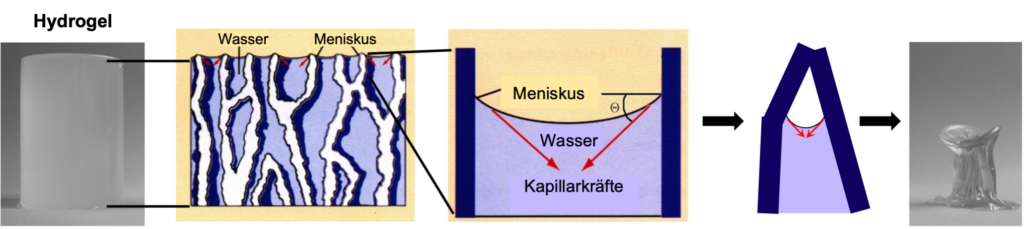
Capillary forces also occur when liquids evaporate in narrow hollow spaces, namely when the water at the pore exit has already evaporated, but the pore “holds” the liquid due to capillary forces. A so-called “meniscus” forms, a curved surface, see Figure 3 in the illustration.
The rule is: the narrower a tube or hollow space is, the greater the capillary force! Since the pores in gels are extremely small, very strong capillary forces occur when liquids evaporate in these pores. However, since these act into the interior of the pores, they pull the pore walls together, and the pore is destroyed as the walls collapse (see Figure 4 in the illustration).
We can observe this effect, for example, when we dry a hydrogel slowly in the air (or faster in the oven). We can also observe the effect of capillary forces in everyday life: for example, when fruit and vegetables dry in the air, they wrinkle and shrink because the pores in the fruit are destroyed by capillary forces. Sounds complicated? Here’s a simple short summary:
Summary answer to the question: Can we produce aerogels by air drying?
- Aerogels cannot be produced by air drying because when the water in the pores evaporates, strong forces occur at the phase boundary that act into the interior of the pore and pull it together -> “capillary forces“
- The capillary forces are higher the smaller the pore is.
- Therefore, the occurrence of capillary forces must be strictly prevented during aerogel production! For this purpose, “supercritical drying” is used.
- In supercritical drying, capillary forces are bypassed because there is no simultaneous liquid and gas phase with a phase boundary, but only a transition without a phase change between the liquid phase and the supercritical state, and later between the supercritical state and the gas phase.