
What is a solvent? Solvents (colloquially also: dissolving agents) are chemical compounds that dissolve other substances without a chemical reaction occurring between the two. Mostly, solvents are liquids, such as water or alcohol. For example, water is a good solvent for table salt.
In a solvent exchange, one solvent is logically exchanged for another.
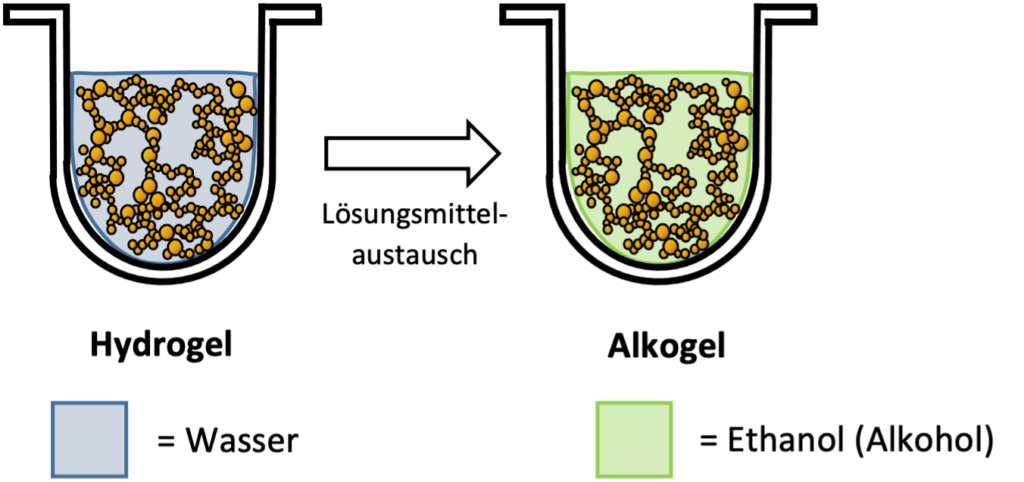
In the production of aerogels, during solvent exchange, we replace water in the pores with ethanol. Subsequently, the ethanol is replaced by another solvent, so-called supercritical carbon dioxide, because only with this can the structure be preserved during drying.
But why is solvent exchange needed for aerogel production in the first place, and why is the water in the pores exchanged for ethanol?
The reason is as follows: The liquid must be removed without a phase change between liquid and gas occurring. Therefore, the supercritical state is used, in which liquid and gas phases are one. However, for water, extremely high pressures and temperatures would be required for this (see table), which could damage the structure on the one hand and result in high production costs on the other. With ethanol, these conditions are already better, but even better with carbon dioxide. However, a direct switch from water to carbon dioxide would also be problematic, as water and carbon dioxide do not mix well. Ethanol is a good intermediate step.
| Substance | Temperature | Pressure |
|---|---|---|
| Water | 374.12 °C | 220.9 bar |
| Ethanol | 240.75 °C | 61.5 bar |
| Carbon dioxide (CO2) | 30.98 °C | 73.8 bar |